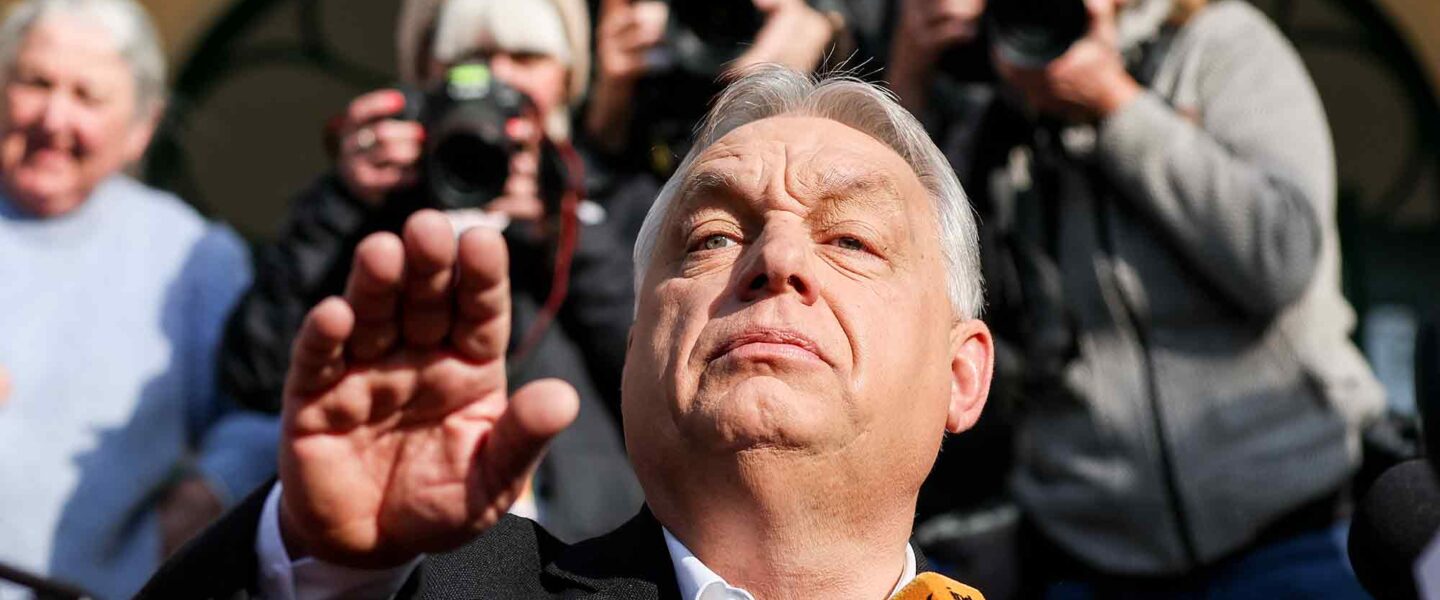
Viktor Orbán’s defeat drew early hurrahs, yet the world beyond Hungary offers a sobering reminder that authoritarian forces remain far from vanquished.
|
Listen To This Story
 |
European officials, liberals, and proponents of democracy celebrated when Hungarian Prime Minister Viktor Orbán was voted out of office earlier this month.
They may have celebrated too soon.
To be sure, Orbán’s defeat removed a thorn in the European Union’s side.
And it came on the back of the French far right’s failure to win control of a single major city in the March municipal elections and Donald Trump’s emergence as a divisive rather than a unifying far-right figure after he apprehended Venezuelan President Nicolás Maduro and began seeking control of Greenland.
The far right’s poster boy, Orbán was an icon of civilizational, illiberal rule who obstructed European policies and maintained close ties to fellow civilizational leaders, such as Russian President Vladimir Putin and Israeli Prime Minister Benjamin Netanyahu.
Nevertheless, the real litmus test for the far right’s global prospects will be when Israelis go to the polls in October, and Americans vote in midterm November elections.
Republican losses in the midterms and the ousting of Netanyahu, should either or both come to pass, would be likely to resonate far beyond the ripples caused by Orbán’s defeat, if only because of the United States’ status as a superpower and the Israeli leader’s impact on international relations and the world order.
A loss of even one chamber of the US Congress, let alone both, would end the legislative phase of Donald Trump’s presidency. Instead, the president would face two years of oversight hearings and, potentially, impeachment proceedings that would put his administration on the defensive and could tie it up in knots.
If voters oust Netanyahu, his successor is likely to bevel the rough edges of the prime minister’s tenure, the longest in Israeli history, including rolling back some judicial reforms.
But while the impact of US and Israeli political shifts is potentially far greater than that of what’s transpired in Hungary, the shifts themselves may turn out to be underwhelming.
The Israeli opposition, if voted into office, promises a less far-reaching reversal of Netanyahu’s policies than the degree of change envisioned by the incoming Hungarian prime minister, Péter Magyar, a conservative politician and former Orbán ally. And in the US, the impact of a Democratic midterm victory would likely be a legislative stalemate and an ongoing battle between democratic and authoritarian forces.
While many are likely to sigh in relief if voters put Trump and Netanyahu on the back foot, their setbacks would likely fall well short of a panacea.
As a result, electoral defeats suffered by Netanyahu and Trump, while they would open the door to reversing the slide towards authoritarianism in democratic societies, would not guarantee a Magyar-scale reversal (assuming that Magyar does indeed follow through on his stated plans) in their respective countries. While many are likely to sigh in relief if voters put Trump and Netanyahu on the back foot, their setbacks would likely fall well short of a panacea.
A Telling Incident
The curtailing of freedom of speech, now common in the United States and Europe on university campuses and in public manifestations regarding the Israeli-Palestinian conflict, was on full display in Berlin last week, when a German police officer instructed a pro-Palestinian demonstrator on what she could and could not chant.
The officer politely asked the protester to stop chanting “Palestine will be free from the river to the sea.”
The phrase “from the river to the sea” is used both by ultra-nationalist Israelis and their supporters and by Palestinians and their backers, albeit with different meanings.
For ultra-nationalist Israelis, it articulates their claim to historic Palestine from the Mediterranean Sea to the Jordan River that includes the West Bank, Gaza Strip, and East Jerusalem, conquered during the Six-Day War in 1967.
For some Palestinians, it means the creation of one state in historic Palestine, while for others, it is a call for the creation of an independent Palestinian state alongside Israel and equal rights for Palestinians with Israeli nationality.
“What shall I say?” the Berlin protester asked when the police officer warned her that he would have to arrest her if she continued to chant “from the river to the sea.” Answering the question, the police officer said, “This sentence is forbidden… in Germany.”
Orbán’s ouster is a success in a European and global environment that is, at best, a mixed bag in which rights remain in peril in democratic as well as authoritarian and autocratic societies.
Similarly, developments in Asian countries — including South Korea, Japan, India, and Indonesia — constitute a cautionary tale.
In a recently released Amnesty International report, the section on Indonesia warned that “authoritarian practices, especially restrictions on freedom of expression and assembly and excessive use of force, increased as the government suppressed dissent and police arrested and detained protesters across the country.”
In a similar vein, Japan’s far-right Sanseito party’s anti-immigration motto, “Japanese First,” boosted its parliamentary presence more than sixfold from 2 to 13 seats in February’s elections.
Far-right South Korean youth have rallied in recent months around former President Yoon Suk Yeol, who was sentenced to life in prison for his 2024 declaration of martial law and attempted insurrection, with signs that read “Make Korea Great Again” and “Stop the Steal.”
In the Middle East, the Iran war prompted a further crackdown on freedom of expression in the Gulf’s six autocratic monarchies, which already curtail individual freedoms.
“As with autocrats everywhere, the danger is that this suppression, occasioned by the pressures of an active war, could outlast the conflict itself, worsening already dismal track records on freedom of expression,” said scholars Frederic Wehrey and Charles H. Johnson.
This week, a new Russian law gave the country’s main domestic intelligence and counterintelligence agency, the Federal Security Service (FSB), significantly enhanced powers.
The law allows the FSB to access databases of any organization, including financial institutions, without a court order; obliges universities to report contacts with foreign educational institutions and companies; blocks Russians’ access to the Internet; and allows the FSB to operate its own detention centers.
Outlook: Still Mostly Cloudy
Orbán’s ouster is a success in a European and global environment that is, at best, a mixed bag in which rights remain in peril in democratic as well as authoritarian and autocratic societies.
For Europeans, liberals, and democrats, Orbán’s fall poses challenges that go beyond the rollback of the former prime minister’s policies, including de facto control of the media.
Political analyst H.A. Hellyer argued that Orbán’s removal and Magyar’s rise offer Europe an opportunity to define itself.
“Will it mark a substantive shift away from the illiberal, identity-driven politics that defined the Orbán era — or will elements of that worldview persist in more muted forms?” Hellyer asked, referring to the former prime minister’s propagation of a homogeneous Christian nation that upholds conservative values. “And more broadly, how will a ‘new Hungary’ position itself on questions of diversity, pluralism, and migration across Europe — especially at a time when ‘great replacement’ narratives have moved from the fringe into more mainstream political discourse?”
The “great replacement” theory claims that political elites, including Jewish elites, use nonwhite immigration from primarily the Middle East and Africa to replace white Europeans and marginalize white Christians.
“These are not abstract questions. They go to the heart of how Europe … engages with its southern neighborhood,” Hellyer said.
James M. Dorsey, an associate editor of WhoWhatWhy, is an adjunct senior fellow at Nanyang Technological University’s S. Rajaratnam School of International Studies and the author of the syndicated column and podcast The Turbulent World with James M. Dorsey.
