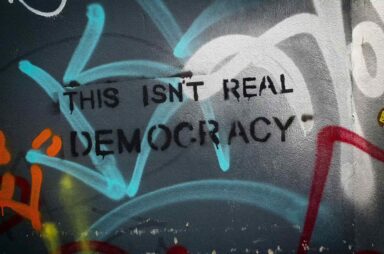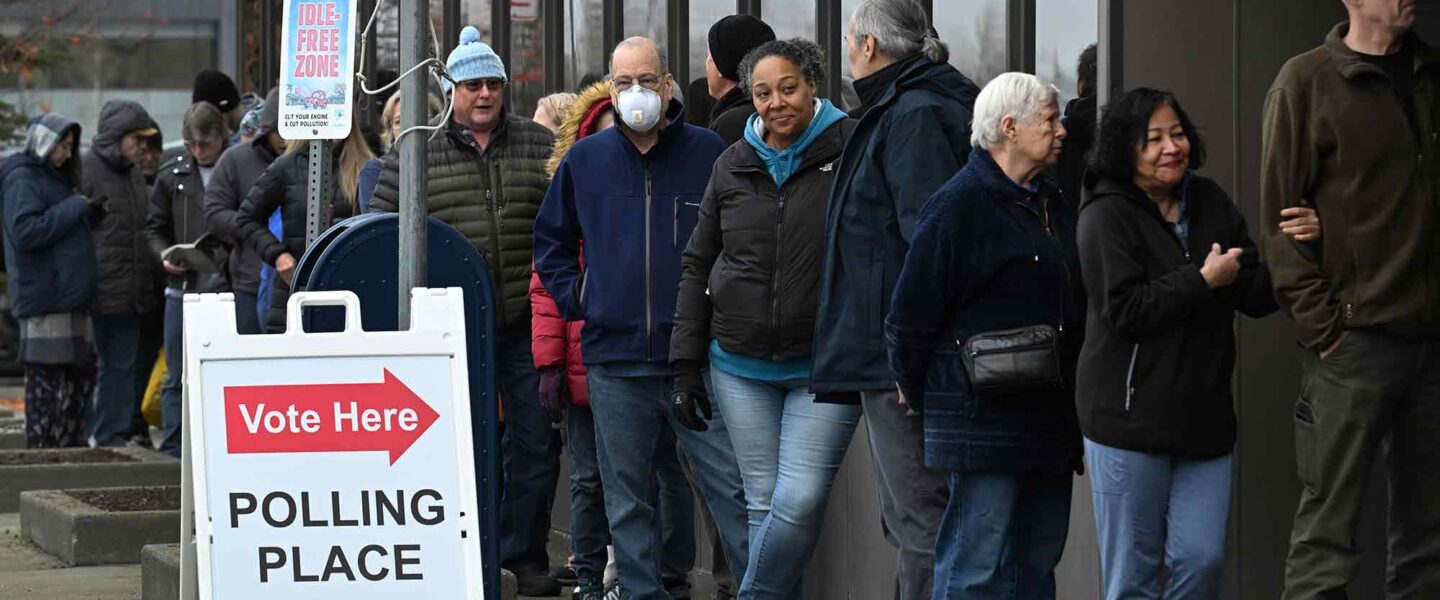
The two-party system in the US primarily serves the two parties and their wealthy donors. However, there are some short-term fixes that could give voters more of a voice in who gets to represent them.
|
Listen To This Story
 |
To illustrate the twisted, scheming, and confusing state of politics in the US, we need look no further than Nebraska.
Democrats there are rejoicing because a candidate with no intention of running in the general election — and who had to sue her way onto the ballot after the Republican secretary of state (who was defeated Tuesday night for not being MAGA enough) tried to disqualify her — won the Democratic Party’s Senate primary by vanquishing someone who did want to compete in the midterms but only to help the GOP win.
Are you still with us? Because that’s not all.
Things got even better for the Ds when the candidate who won the Democratic primary in the state’s second congressional district defeated a state legislator who might have resigned his seat had he prevailed, which would have allowed the Republican governor to appoint a replacement and give his party a supermajority, which could then change Nebraska’s election rules, which currently award the state’s Electoral College votes not on a winner-take-all basis but rather based on which presidential nominee wins each district, thereby effectively eliminating the “blue dot” and helping the GOP win a super-tight election race for the White House in 2028.
Got it?
All of this is happening against the backdrop of a national Republican Party that, at the direction of the most anti-democratic president in history and aided by a hyper-political Supreme Court (and various partisan state courts), is hellbent on rigging the midterms by engaging in an unprecedented mid-decade redistricting spree that is shattering norms, bending rules, and breaking laws with the implicit goal of rendering completely meaningless the votes of nearly all Black Americans living in the former Confederate States (and a few others) in the upcoming House elections.
And, if they know what’s good for them, Democrats, who were unable to redraw “their” maps as effectively this year, are surely plotting how they can circumvent safeguards they themselves once put in place in blue states to prevent gerrymandering — in an effort to ensure that they do not fall too far behind in a race to the bottom that disenfranchises Americans of all political ideologies, ensures the election of more extreme candidates, further divides a country that keeps drifting apart, prevents passage of nonpartisan consensus legislation, and virtually guarantees that tens of millions of people grow even more disenchanted with politics and the political system.
It. Does. Not. Have. To. Be. This. Way!!!
There are plenty of people who believe that the American Experiment has failed after 250 years, that the country has been irreparably broken — not only by Donald Trump, who just happened to give it the killing blow, but rather over the past couple of decades — and that we may be headed for a split because the United States of America no longer exists.
However, even though the nation seems more fractured now than at any point since the end of the Civil War, we don’t think that it is necessary to break up the US — just the two parties governing it.
While that may sound difficult, it would certainly be easier than it would be for California and/or other blue states to secede.
Most importantly, the mechanisms to make it happen already exist and/or could be put in place.
But before we get to that, let’s first envision a more perfect Union.
Clearly, the two-party system isn’t working, especially not in its current form.
Not so long ago, there was plenty of overlap between conservative Democrats and liberal Republicans… enough to allow them to work together on things or at least not spend all of their time in partisan warfare.
It’s this type of coalition building we have to get back to.
However, that seems impossible in a political environment in which 90 percent of lawmakers can be assured of a seat in the House of Representatives as long as they win their primary — which also means that the vast majority of them are chosen by a few extreme partisans.
The obvious solution would be to give Americans more choices.
But how can that be accomplished when the system is rigged against the emergence of another party?
Ideally, both of the existing parties would split into two and leave voters to choose among MAGA, traditional Republicans, establishment Democrats, and a progressive alternative on the left.
That would virtually guarantee that none of them can go it alone and instead would need to compromise to get the required majorities.
For example, let’s take one of the most controversial bills currently before Congress: the poorly named SAVE America Act.
There is a provision in it that Americans broadly support: that voters present an ID when they want to cast a ballot. However, in the way the legislation is written, it threatens to disenfranchise millions of voters.
But would it be possible for more sensible lawmakers to come to an agreement that achieves the former without doing the latter — for example, by allowing different types of ID and/or ensuring that Americans who need to obtain the identification do not face unreasonable hurdles when doing so? Sure.
And could such legislation also be combined with automatic voter registration at birth or naturalization, which would achieve the goal of allowing only citizens to vote? Yes, if reasonable people and not anti-democratic zealots were writing those bills.
Unfortunately, it seems unlikely for either party to want to split into two, although it would be great if there were some sort of post-Trumpocalypse in the GOP and a realization among Democrats that the establishment center is far away from a much more progressive base on many issues. After all, for either party to do so unilaterally would result in electoral doom.
So, how then can there be a greater diversity of candidates that gives voters a more meaningful say in who gets to represent them?
Fortunately, there are ways already being used across the country that achieve just that.
One of them is California’s “jungle primary,” in which all candidates are running on the same primary ballot and the top two, regardless of party affiliation, advance to the general election. A version of it could be used across the country.
It would be especially effective in combination with ranked-choice voting, which allows voters to list candidates in order of their preference.
Then, all the votes for candidates ranked first are counted. If nobody gets a majority in the first tally, the candidate with the fewest votes is eliminated. But here is the wrinkle: In the next round of counting, the votes on ballots on which the eliminated candidate was listed first go to whoever is listed second. And that process keeps repeating until someone wins a majority.
Californians decided to implement the jungle primary in 2010, and Mainers voted in favor of a switch to ranked-choice in 2016. Four years later, Alaskans approved a ballot measure to adopt a system that combines the two: using ranked-choice voting, the top four candidates in the state’s primary advance to the general election.
In other words, voters in these states made the decision which method to use… and this can happen anywhere.
Yes, lawmakers in Republican states have made it extremely difficult to put these kinds of initiatives on the ballot. However, whenever activists succeeded, voters there routinely voted for things like Medicaid expansion or pro-abortion rights amendments.
We are also not saying that the jungle primary, ranked-choice voting, or a combination of the two is the optimal solution. We’re sure other systems already exist or could be created that achieve the same goals.
That being said, just about anything would be better than what is in place now: a system in which lawmakers pick their voters instead of the other way around and that favors the election of extremists who are unlikely to ever compromise once they are in Congress.
And, once more reasonable people have been elected, let’s outlaw gerrymandering altogether by making district mapping nationwide a task performed by nonpartisan independent commissions using specific metrics to ensure they are representative of the populace, pass comprehensive campaign finance reform, and return the power to the people instead of politicians and the people who write them the biggest checks.