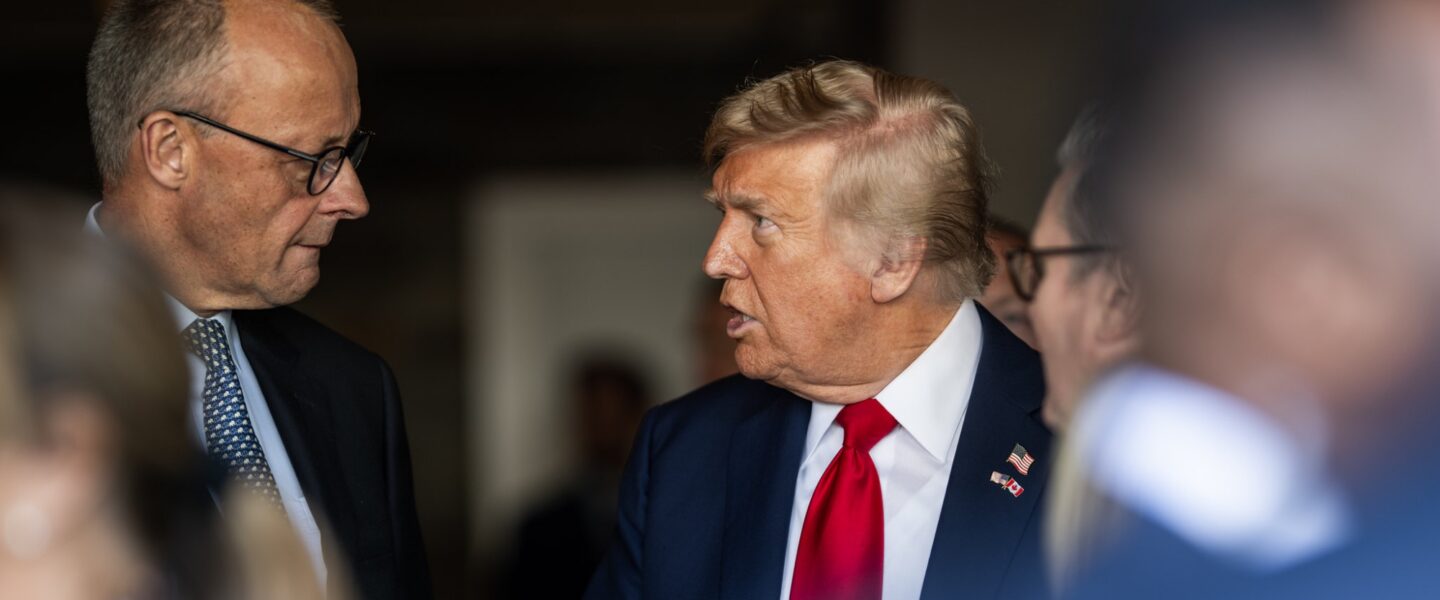
Countries dealing with Donald Trump must choose between standing up to him or never-ending subservience. For inexplicable reasons, leaders like German Chancellor Friedrich Merz choose appeasement and place themselves at the whims of the president.
|
Listen To This Story
 |
Of all the countries in the world, Germany should know best that, in the long run, appeasing erratic strongmen is a losing proposition. And yet, in an effort to mollify Donald Trump, that is the strategy its Chancellor Friedrich Merz had pursued for more than a year — until this week, when it all fell apart after he dared to criticize the president’s lack of a plan to get out of his war with Iran.
Since his remarks to a group of German students, which also included a comment on how the leadership in Tehran had “humbled” the United States, the thin-skinned Trump has repeatedly slammed the chancellor on social media; put in place a 25 percent tariff on cars and trucks shipped from the European Union to the US, which will affect German automakers; and ordered the withdrawal of 5,000 troops from Germany.
And just like that, months of sucking up to the president were all for naught.
What is most baffling about this episode in transatlantic relations is not that Trump is so sensitive that he cannot stand to be criticized, or that he will undermine US security because he felt slighted.
That’s not us talking, by the way, but rather the Republican chairmen of the Senate and House Armed Services Committees.
“We are very concerned by the decision to withdraw a US brigade from Germany,” said Sen. Roger Wicker (R-MS) and Rep. Mike Rogers (R-AL). “Germany has stepped up in response to President Trump’s call for greater burden sharing, significantly increasing defense spending and providing seamless access, basing, and overflight for US forces in support of Operation Epic Fury.”
The lawmakers added that a troop withdrawal would send the wrong signal to Russian President Vladimir Putin, who usually gets what he wants from Trump without coddling him.
Rep. Adam Smith (D-WA), the ranking Democrat on the House Armed Services Committee, spelled things out more clearly.
“It doesn’t matter that our presence in Germany is essential to our national security,” he stated. “All that matters are the hurt feelings of a president who is seeking political vengeance.”
What is truly astonishing is that any world leader still thinks that appeasement works with an American president who governs like a mob boss.
Short of giving him more and more and more, the only language Trump understands is strength.
Merz and other European leaders should take a page from the playbook of the same Iranians who the chancellor says are humbling the US right now, because they are using whatever leverage they have to put the president in a tough spot instead of choosing to kowtow to him.
And it’s not as though they don’t have ways to put pressure on Trump; they are just too afraid to use them because it might lead to some short-term pain (unless the president pulls a TACO).
An added benefit to standing up to him is that Europeans despise the US president.
For example, just 10 percent of Germans have a favorable opinion of Trump while 86 percent hold a negative view of him. Therefore, it even makes sense politically for a vulnerable leader like Merz to show some spine.
And if he won’t do it, then other German politicians will… and reap the rewards.
For example, Lars Klingbeil, the country’s vice-chancellor and the head of the Social Democratic Party, which is the junior partner in Merz’s coalition government. Following Trump’s threats, he noted that Europe’s economic might means that it must not allow itself to be blackmailed by anybody before stating that Germany should not be dependent on whichever mood Trump is in.
In this case, there is one more reason for Germany not to give in: Congress will get a say in the matter of the troop withdrawal, and even GOP lawmakers who are usually extremely subservient to the president may not stand for such a move.
“Any significant change to the US force posture in Europe warrants a deliberate review process and close coordination with Congress and our allies,” said Wicker and Rogers in their joint statement. “We expect the Department to engage with its oversight committees in the days and weeks ahead on this decision and its implications for US deterrence and transatlantic security.”