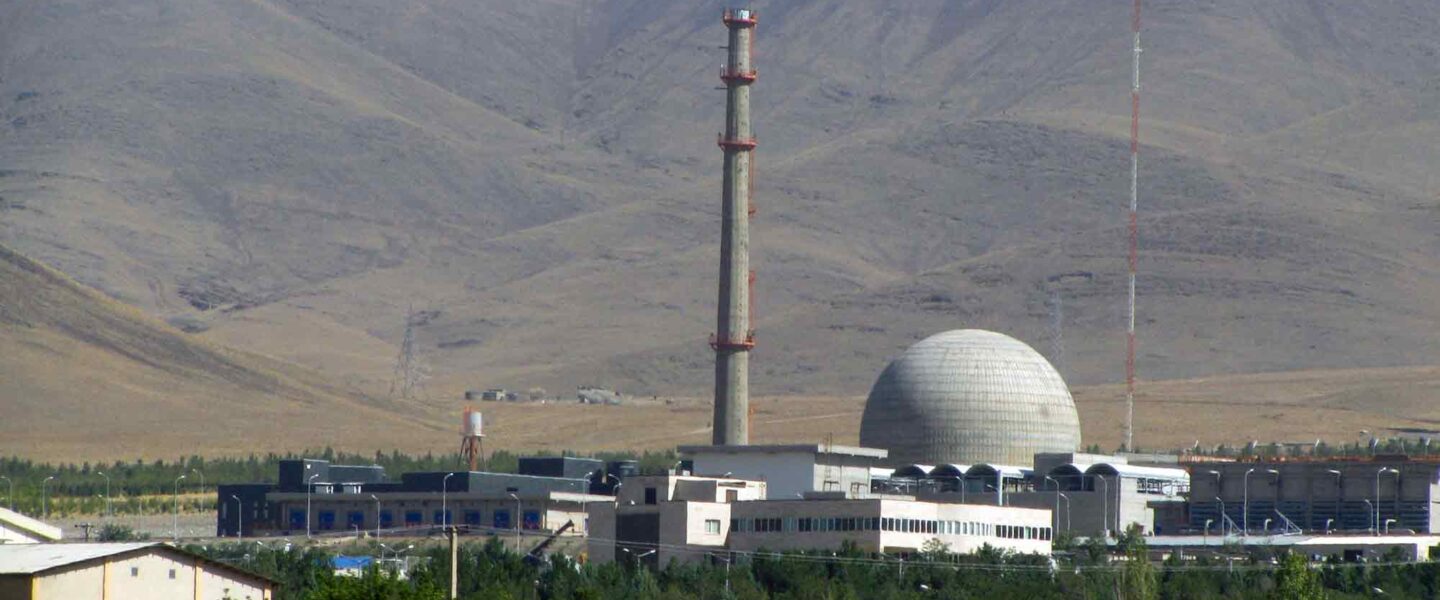
Iran’s real conflict may have less to do with uranium than with a regime losing control of its people, its proxies, and its purpose.
We’ve been afraid of the wrong thing. For more than 20 years, the Iranian nuclear program has dominated the conversation — the centrifuges, the enrichment levels, the endless countdowns to “breakout.” But in this conversation, Alex Vatanka, director of the Iran Program at the Middle East Institute, asks a more provocative question: Why does the world treat Iran so differently from Pakistan or North Korea, both of which already have nuclear weapons?
His answer reframes not just the nuclear debate, but the way the West has misunderstood Iran itself.
Vatanka takes us inside the larger struggle now unfolding in Tehran — a regime that spent 40 years building its identity around exporting revolution through Hezbollah, Hamas, the Houthis, and Shia militias across the Middle East. But after October 7 and Israel’s sustained campaign against Iran’s proxy network, he argues the Islamic Republic is confronting something deeper than military losses: the collapse of the narrative that justified the revolution in the first place.
Along the way, Vatanka explores one of the great untold ironies of modern Iran: how a theocratic revolution may have created a backlash, resulting in the most secular society in the Middle East.
He talks about the growing divide between the regime and ordinary Iranians, the fractured and often politically ineffective diaspora, the internecine battles inside Tehran’s leadership, and why America still seems unable to decide whether it wants coexistence or regime change.
And then there’s China. Vatanka describes Iran as “China’s gas station” — a clever phrase that opens up an entirely different way of understanding who really benefits from Iran’s isolation, and how the balance of power in the region may already be shifting beneath America’s feet.
This is a conversation about far more than nuclear weapons. It’s about ideology, identity, power, and whether the Islamic Republic is capable of a transformation — or if this is the beginning of its end.
 Apple Podcasts
 Google Podcasts
 RSS
RSS
Full Text Transcript:
Jeff Schechtman: Welcome to the WhoWhatWhy podcast. I’m your host, Jeff Schechtman.
There’s a particular kind of exhaustion that sets in when a crisis won’t resolve, when the headlines keep coming, but nothing seems to change. When the analysts keep appearing on television and diplomats keep meeting in hotel conference rooms, but the needle refuses to move. Most of us have reached that point with respect to Iran. We think we know the story: nuclear ambitions, maximum pressure, a Supreme Leader nobody’s actually seen in months, a president who threatens military strikes one day, announces a breakthrough the next, and contradicts his own negotiators the day after that, a cease fire that gets violated before the ink dries. We’ve heard it. We’re tired. But there’s a difference between knowing the headlines and understanding the architecture. And the architecture of what’s happening inside Iran right now — who’s actually making decisions, what they’re willing to trade, what they’ll die before conceding, how they read Trump, how they read us — that’s a story most of the coverage has missed entirely.
My guest today, Alex Vatanka, has spent his career inside that architecture. Vatanka reminds us that part of what’s missing is the proxy story: Hezbollah, Hamas, the Shia militias across Iraq and Syria, the Houthis in Yemen. Israel understood that this network was the regime’s proof of concept, its argument to itself that the Islamic Republic mattered beyond its borders — and dismantled it with a precision and persistence. The rest of the world is still processing what fills that space now, and what does a regime do with its identity when the evidence for that identity keeps getting bombed? But there’s something else missing, too, something older and deeper than any of the current headlines. For four decades, the Islamic Republic has been fighting a war with itself, not with Israel, not with the United States, with itself. In the early post-revolutionary years, the rivalry between Khamenei and Rafsanjani wasn’t just a personality conflict, it was the template for how this regime has always worked: factional, tribal, each power center protecting its own equities, Iran’s national interests perpetually held hostage to the internal power struggles. That dynamic didn’t die with either man. It metastasized. And here’s what makes it truly tragic. Iran is arguably the most secular country in the broader Middle East, more secular than Turkey, more secular than the Gulf states, a population that wants what most people want: to not be sanctioned, to participate in the world, to have a future. A people, in other words, who could have built something remarkable. Instead, the regime’s internal tribal warfare has consumed whatever opening history gave them. Understanding that may be more important to reading what’s happening next than anything being said in conference rooms in Islamabad.
Alex Vatanka is the founding director of the Iran Program at the Middle East Institute in Washington. He was born in Tehran, raised in London, and he’s one of the few analysts who can move fluently between the factional logic of the clerical establishment, the institutional DNA of the Revolutionary Guards, and the peculiar way Iran reads — and frequently misreads — the American political system. He’s testified before Congress when others were still learning names, and it is my pleasure to welcome him here today to the WhoWhatWhy podcast. Alex, thanks so much for joining us.
Alex Vatanka: Oh, Jeff, thank you so much. What a wonderful, warm introduction. And I thought you did an amazing job laying out the landscape in terms of what we’re looking at as we try and unpack modern-day Iran and all the troubles that country is faced with.
Jeff: Well, let’s talk about some of those troubles. And perhaps one of the things that we’re misreading at the moment is that we keep looking at Iran’s behavior in terms of trying to see it as bad faith, to see it as stalling in terms of its response to the US proposals. But as you indicate, there’s a lot more going on there. Talk about that first.
Alex: Yeah. Look, obviously the world looks very different depending on your vantage point. And if you’re sitting in Tehran today, if you’re one of the members of the Islamic Republic, one of the ones who has not been killed in the course of this latest war or the war that happened during the course of the 12-day war of 2025. If you’re one of those remaining Iranian leaders, how does the world look to you right now? Number one, I think where they’re at is to prevent the resumption of the war. Now a lot of them think it will happen. They’re anticipating that the US and Israel will attack Iran again and the war will resume. But I think overall, my reading of the situation in Tehran is: if they can prevent it from happening, they’ll do their best. Not at any cost, Jeff, and that’s something I’m hoping we can get back to in terms of what they’re looking for as part of a deal, but I don’t think this is a suicidal regime. I don’t think they want war. They don’t underestimate the capacity the United States and Israel jointly to hurt them far more so than has already been the case.
And let’s just for a second put this idea of where they are in terms of the conflict aside, let’s even assume that somehow they find a temporary resolution, that the cease fire will hold. We don’t go back to war. Then what? And that in many ways is the tougher question for this, what’s left of this Iranian regime, because then it has to turn around and face its own people, a people that have for the last 47 years, in so many ways, shown again and again that they do not approve, nor do they want to live under the conditions that have been brought upon them, thanks to the policies of the Islamic Republic. And that is the deeper challenge of the Islamic Republic. Its own people, the fact that they are by and large, and I don’t want to exaggerate and say 99 percent, I would say about 80 percent or so of Iranians, have had enough. They want to move on. They want to go in a different place in terms of their lives. And once this war is over again, if it is over, the regime still has to come up, if it can, with an answer to that challenge that is coming from the people. I don’t see any indications that they have that answer. But that’s not going to mean they don’t have to think hard about, see if we can find that answer to the lack of legitimacy that they essentially have in the eyes of the ordinary Iranian people.
Jeff: Given that framework, what should Washington, what should the administration, in an ideal world, be asking for at this point?
Alex: You know, I live in Washington, DC, I work on Iran daily. I see people who are in the same field. We interact with the policymaking community. One of the things we see clearly is that by and large — and I don’t want to put the blame at the door of the Trump administration alone, or the Biden administration, or the ones that came before. In reality, for many years, the United States has not been able to make a fundamental decision to coexist, to learn to live with the Islamic Republic, with the leaders that it has and the policies that they espouse, or to try and find a way to bring it down. That fundamental decision hasn’t been made. Instead, we’ve been somewhere in between the two. Not really convincing Americans, certainly not convincing the Iranian leaders who always second-guess what the American ultimate aims are when it comes to the US policy toward that country. So I would start with that, Jeff. I would start because that decision, what do you want, coexist with them or get rid of them? That would shape all the policy choices basically going forward.
And right now, we find ourselves in a situation where the Trump administration clearly has accepted that this Islamic Republic is not going to go anywhere. We certainly don’t see any evidence of the US trying to mobilize the opposition inside of Iran or the Iranian diaspora to get the regime down. What they’re doing instead is the Trump administration is focusing on a couple of core issues, Iran’s nuclear program, the reopening of the Strait of Hormuz and so forth. Now, those are actually diplomatically achievable. Those are things you can reach a deal with this Iranian regime, Iran. Is that good enough for everyone? Probably not. A lot of people think the best thing you can hope for is the end of this regime, because it is a regime that is essentially headed by a majority of Iranians. So why not help those Iranian people get rid of it? And that’s a fine proposition, but it requires political attention, determination, investment in the project that could require a lot of American focus. And we don’t see that in this Trump administration, nor do we see it in the Biden administration before it or the administrations before that. So again, as someone who sees this up close, to me, the challenge has always been, make your decision. You want to coexist with this regime? Are you able to coexist with this regime and everything it stands for and all the things it’s done to the United States or the US has done to it going back to 1979? Or do you really think with the right attitude and investment, this regime can actually be toppled by the Iranian people? It doesn’t have to be like the Iraq project or Afghan project. It could be something very different. But the Trump administration clearly is not in the business of regime change. That much is clear as of today. And the question is, can they then cut a deal with this Iranian regime around those narrow areas where that’s the nuclear issue and the Strait of Hormuz. And, you know, again, that likely is the best we can hope for as of today.
Jeff: Was it the original idea, though, of something like the JCPOA to create the environment and the trust ultimately over a protracted period of time that would enable the kind of coexistence that you’re talking about?
Alex: You know, I don’t want to put up a defense of any policy, but since you mentioned, Jeff, the JCPOA, the reason why the Obama administration went down that path and just focused on the nuclear issue was because that was the one issue that the US cared about the most. That was the one issue that was most pressing from the perspective of American national interests. So they focused on that and they got a deal out of it. They knew, the Obama administration 11 years ago knew, if you talk about Iran’s missiles and their proxies and their human rights violations of the Iranian people, then there’s no chance of a deal. So they made a decision back then to focus on the nuclear issue, and they got a deal. The Trump administration that walked away from that deal back in 2018, the first Trump administration wanted something, as the president would say, bigger and better. And he has tried, he has put maximum pressure on Iran and most recently had gone to war with them. And the regime is still standing now. What lesson does the president draw from that, that it’s not worth it? Maybe go back and get a slightly better deal than Obama got in 2015 and call that a victory and move on? Or maybe still try and see if he can get what you were talking about, Jeff, the beginning of a process that actually goes way beyond just focusing on the nuclear issue, that creates the pathway to eventually normalization of relations between the two countries, which would entail the Iranian regime changing its policies on some important issues, for example, its regional agenda in terms of how, at least from an American perspective, it meddles in the affairs of countries like Iraq and Lebanon and Yemen and the Gulf countries. Or an Iranian regime that actually takes a different approach to its own people, respects the basic dignity of Iranian citizens more and so forth. And essentially what I’m saying is 2015 was, by design, a narrow pathway focused on the nuclear issue. The Trump administration could choose something very similar to that, not because that’s what he wanted to, but because it’s forced to accept that, because the alternative is a wider war that the Trump administration is not willing to sign up to do. But you do have… this war has created a condition for both Washington and Tehran to actually accept the fact that war on a large scale is a lose-lose scenario, and that both countries are better off finding a way to coexist, if you will. And that, again, requires more than just compromises on the number of centrifuges or how many kilograms of enriched uranium Iran is allowed to have, or even how the range of Iran’s ballistic missiles will be. It has to be bigger than that, and it is not going to be, it cannot be a debate about Iranian capabilities. It has to be about changing Iranian intentions— and for that matter, you could say American intentions toward Iran because it really does take two to tango.
Now, I say all this, all this, Jeff, and it sounds very kind of logical, perhaps to many, but I can also hear people who are saying, what are you suggesting, that the United States finds a way to coexist with this regime that just a few months ago killed tens of thousands of its own citizens who came out to protest against it? And I appreciate that. And I’m not saying it’s going to be easy thing to do in terms of looking at it from a moral point of view. But I’m saying, what is the alternative? And in that sense, you could make the case for a diplomatic approach that begins with resolving the core issues of today. Again, the nuclear issue. Strait of Hormuz reopening. You build trust. And along the way, baby step after baby step, you build enough confidence that maybe you can arrive to a point where you can say, now relations have fundamentally changed. We’re not going to go back to the days of the Shah, 1979, but nor do we have to be where we’ve been for the last almost half a century of these two countries being at loggerheads over so many different files. And, you know, certainly from an American point of view, costing US national interest quite a bit.
Jeff: All of that has a certain internal logic to the extent that we’re talking about two countries, to the extent that we’re talking about Washington and Tehran. But to the extent we’re still talking about Iran’s projection of its power into the region, through its proxies, through Hamas, through Hezbollah, through the Shia militia, and the reaction of Israel, the equation is entirely different. Talk about that.
Alex: Yeah. Look, this question takes us to the core of a big policy fight that’s been going on in Iran, in fact, for a long time. What is this regime? What is the Islamic Republic for? I mean, fundamentally, is it there to serve the basic needs of the people of Iran? Which I think a good part of the regime believe it should be focused on improving the conditions of life for ordinary Iranians. Or do you believe those who are of the ideological mindset that says, you got it all wrong, this life on earth isn’t about just, you know, having good economic conditions and a pleasant life. It’s about being good human beings so you can go to afterlife. So very much a religious mindset that doesn’t look at this world in the same way that probably the vast majority of people in Iran look at, which is far more secular, as you pointed out so accurately in the introduction. This fight is going on.
Now, the ones who are in the driver’s seat are the ideologues, are the ones who believe that too much focus on life on this earth is a mistaken approach. That instead, they should go out there and spread the message of the revolution. Spread the message of Ayatollah Khomeini, who in 1979 toppled the Shah. You spread that to places as far away as the Mediterranean, to places like Lebanon, to places like Syria, to Iraq, Yemen. And that’s what this regime has done for a long time, invested hundreds of billions of dollars. Now, you could have made the argument five or six years ago that it gave Iran an ability to project power in the region. The Iranians could say that their presence in South Lebanon meant that they could project power over the state of Israel, or that being in Yemen meant that they could close the Strait of or the Bab el Mandeb and so forth and so on. So that might have been the case back then, but I think so much has changed after the Hamas attack on Israel, October 7, 2023. The Israeli decision to go on the offense to confront Iran’s proxies, whether Hezbollah, Hamas, elsewhere, the Hashd al-Shaabi, the Iraqi groups. And this has now really put the pressure on the Iranian regime, even the ideologues who now have to answer, more so than ever before, whether it’s worth being in the region, whether it’s worth spending so much blood and treasure spreading the message of Khomeini, particularly at a time when so many Arab populations don’t necessarily seem receptive to what the Iranians have to offer.
And again, this takes us back to this fight in Tehran. The ideologues, whether you like it or not, are still the ones who are in the driver’s seat. But once this war subsides or ends somehow, and they will eventually, they have to then explain to their own people what’s left of the treasury, of the money, what’s left of that, should that be spent on basic needs of Iranian people who live inside of Iran, or continue to equip a militant foreign policy that, for example, as we all know, focuses so much on fighting the Israelis or fighting the Americans in the Middle East, which if you ask me, Jeff, my honest answer to that is your average Iranian is not interested in those regional confrontations with Israel, the United States and its bases in the region. They want to focus on the things that they care about on a daily basis, that most people around the world care about, your access to food and health care and housing and not being victim to war. That’s what the average Iranian thinks about.
So I think, and that was a long answer to where the proxies come in. But my point is the proxies are a part of a worldview that came about in 1979 that says, this is our revolution, we’ll spread it. But after all these decades, that war that for a long time was being fought outside of Iran’s borders was then brought to Iran itself, including this latest war. And this is why the burden right now has never been as heavy for those ideologues who have been promoting this idea of projecting power in the region to actually stand up and answer for why it works, how it works, and what it’s justified to continue and invest in this direction. Or perhaps the Iranian regime should, you know, charter a new course and go in a different direction.
Jeff: How much of that projection is about projecting the message or how much is simply about the projection of power? Or doesn’t it matter?
Alex: Yeah. You know, I’ve heard this, Jeff, this idea that, thanks to the Islamic Republic, Iran can now project power over, say, Israel from Lebanon or from a few years ago from Gaza or so forth. And to me, you really don’t need to think that long and hard to then ask the follow-up question: did you have to project that power over Israel or over the United States if you took a different approach to those countries? So I think they need to project power is as a result of choices made in the realm of foreign policy, which, in my view, in the Islamic Republic have been hugely ideological since 1979. Not everything they do is ideological, but some of the fundamental decisions they’ve made are ideological. And I think that’s why, you know, so many Iranians would rather have Iran — for example, since we’re talking about Israel — help the Palestinian people, not by providing them with weapons, by providing them with diplomatic support, by, for example, Iran joining other countries around the world in the Middle East, in Europe, in Asia, who do believe the Palestinians deserve a better life, who do believe some of the policies that the Israelis are not good for the Palestinians and are not good for the future of the state of Israel itself. That’s an alternative way of helping the Palestinians, which, so far, the Islamic Republic hasn’t tried, because to this day, technically, it is against the idea of a two-state solution, for whatever it’s worth. So I think, you know, when you ask the question, how much of it is about the message versus projecting power, the two are kind of intertwined in a way, because if you had a different message, the need to project power, the way Iran has tried to project power, really isn’t necessary anymore because this is a large country of 93 million people, the size of Alaska. Iran has lots of different ways of projecting hard and soft power across the broader Middle East. It doesn’t have to limit itself to the mothership of a group of, you know, a small group of militants, whether it’s Hamas or Hezbollah. In the bigger scheme of things, I think Iran could have done much better for itself and for Iranian national interests if it had made some different choices along the way.
Jeff: Has this war so far made the secular voices inside of Iran stronger or weaker?
Alex: One of the ironies of this Islamic Republic was it was created in 1979 in a Muslim-majority Iran, where most people, by and large, would call themselves Muslims. And they didn’t sort of describe that as a political expression of any kind. It was just what they were, like a lot of Americans are Christians that don’t necessarily go to church, and nor do they think of that statement that they’re Christian or Jewish as a political statement. Now, in the case of Iran, 47 years after the revolution, when you say you’re a Muslim today, you’re making a political statement, which is why so many Iranians today are reluctant to even put that label on themselves. Because when you are a Muslim in the Islamic Republic, kind of by definition, you’re saying you’re supporting the policies of this regime. So that’s the irony. The theocracy that was supposed to bring Iranians closer to Islam has done the opposite, has turned Iran into the most secular, if not anti-religious, society, not just in the Middle East, probably internationally as well. This is not something I suspect Ayatollah Khomeini thought he’d end up with. But the policies that he instigated, and the ones that his successor, Ali Khamenei, continued, have turned the people of Iran against religion. Again, it’s not necessarily a vote against Islam, because most people do so not because they have a great knowledge of Islam, they do so because they associate Islam and this government to be one. And if you don’t like the government, then you shouldn’t really like Islam. And that is what has happened to religiosity inside that country. It’s declined in ways that probably is unprecedented, certainly across modern Middle East.
Jeff: What is the role, if any, of the Iranian diaspora in all of this debate?
Alex: Oh, the diaspora oftentimes get dismissed as people who show up in these large marches, whether it’s downtown LA or New York City, in Manhattan, or in European capitals like Berlin and London. And there are large Iranian diasporas everywhere around the world today. As I like to joke, the Iranians over the last half a century have become the Irish of the Middle East. They are now everywhere in terms of immigrant communities, the numbers are hard to pin down, but we’re talking six, seven, maybe more millions of Iranians from New Zealand to Argentina and anything in between. And they are, by and large resourceful, by and large educated, by and large people who have, certainly here in the United States, at the upper bracket in terms of incomes. And as they have gone through the immigrant story here in the United States, as so many other waves of immigrants before them, they’re maturing, they’re now members of Congress of Iranian heritage. They’re not necessarily voting for one party, Democrat or Republican. You see all the Iranian immigrants voting more on the Republican side, a huge amount of supporters for the Trump administration, and then the younger Iranian Americans tend to vote Democratic. And that kind of demographic and generational divide is seen elsewhere in Europe and so forth. So it’s not a monolith in that sense.
But what point is it’s capable of being a force for good if it mobilizes itself properly. And in this last few months, as this war has raged in the Middle East and before the war with the mass killing of protesters, while this energy is there, while they’re angry, while they rightfully want change in their country of their ancestors, they continue to fail to organize in a way that the regime takes them seriously — or the American administration, for example, the Trump administration arguably has not taken Iranian political activists in this country seriously. If it had, it wouldn’t be so keen on negotiating with the Islamic Republic. And that, I think, is the failure of the diaspora. It’s not because it’s not capable. In many ways, it’s super capable. But when it comes to being capable as a political force that can actually put the pressure on the Islamic Republic, on that front, they still have a long way to go.
Jeff: Talk about the nuclear issue and how to get beyond that. I mean, all of this has a certain patina to it that assumes that there’s a way to deal with this… to get beyond the nuclear issue.
Alex: We talk about the Iranian nuclear issue mostly in many ways because of the nature of the Islamic Republic. I mean, we don’t talk about the Pakistani nuclear arsenal as much. And they are, you know, they’re not a democracy, and they didn’t tell the world what they were doing, when they blew up that first nuclear device, it was a surprise to the world. So, they were hiding. In fact, every country that has become nuclear armed hid what they were doing, from 1940s with the United States to the Soviets, to everyone that came before. That’s not unusual in that sense. The Iranians are doing like every other country has done. You hide what you’re doing.
The world cares about the Islamic Republic, in my estimation, so much because of the slogans that are associated with this regime, being an anti-status quo power, being a country that a regime, I should say, that oftentimes speaks about rearranging the global order. Now, you could dismiss language like that. If it’s a country that militarily it doesn’t pose much of a threat. But if it’s a nuclear-armed country, that does certainly change attitudes, and it certainly changes attitudes in the West, particularly the United States, since that part of the world — the West and the Western bloc — is getting most of the attention or anger from the Iranian side, if you will. And the fact that they have, Jeff, the fact that they have pursued policies that are equally troubling doesn’t help either. So for example, let’s put it right next to North Korea. North Korea is not a nice regime. In fact, you could make the argument it’s much nastier than the Islamic Republic in many ways. And it is a nuclear-armed country today. And yet North Korea is isolated, you could make the argument you can contain it. The Islamic Republic has been pursuing a nuclear program while promising regional reorder and using proxies to attack US interests and so forth. So because of that reality, its nuclear program, which, has the potential to one day produce a bomb, but has never actually produced a bomb, nonetheless was enough to create so much concern that, since year 2003, and this is really important, we’ve been talking about this Iranian nuclear program since 2003. Over a quarter of a century, this has been in the news basically weekly. And it’s not just the nuclear program, the centrifuges, and the industrial base that goes around with it. It’s also the political rhetoric that has come from Iran and that has kept this issue in the headlines for as long as it has.
Jeff: Is it too late to change that political rhetoric?
Alex: That’s the big decision this regime has to make. The first-generation revolutionaries of the Islamic Republic are still around. There are still men in their early 60s, some a bit older. But most of these are men who joined the revolution, if you will, as young men in their early 20s. They have gone through a lot together. They’ve gone through the revolution of ’79, the Iran-Iraq war that lasted eight years, the US invasions of Iraq and Afghanistan, and the proxy war of the last 20 years. They’ve gone through a lot as a group of leaders in that country. And yet, you could make the argument they’ve never been in such an awkward place politically as a regime as they are today. Because they’re not confronting just the outside adversaries, principally the United States and Israel. But as I said earlier, their bigger concern ought to be the people of Iran, who really don’t see this regime reflect what they want out of life today.
So, now with Ali Khamenei being killed by the United States and Israel on the 28th of February. The man who ruled Iran for 37 years almost, he’s gone. That in itself is a window of an opportunity to change course. Will the regime change course? Huge question mark. Not in the short term, because right now they’re worried about making sure they survive in the war against the US and Israel, which could restart at any moment. But let’s again assume the war ends somehow. They still have to make that fundamental decision to double down on the past policies which brought this disaster on Iran, or to actually listen to their own people and choose policies that are different, policies that are about the basic needs of the people of Iran who live inside of Iran, and leave the idea of exporting the revolution at any cost, leave that be. That has not been tested, that has come at a huge cost for the country of Iran. Huge number of people have died. Billions and billions has been destroyed in terms of infrastructure. And Iran can choose again, this is very much a subjective view here that I’m offering, because I can tell you that there are people in Iran who tell you that this war is exactly the reason why they should be on the same path they’ve been on, because this is how they’re going to change the world. I think that’s a mistaken belief. I think that’s hubris. I think that’s going to fail. I think the best way for them to go forward as a regime is to change policies, both domestic and foreign, and then hope.
And it still would be hope that they’ll be forgiven by the people of Iran and given another chance to rule over them. Because if they don’t, if they don’t change their policies, the question of how, when the next round of protests in Iran will happen, it’s just one of about timing, because it will happen again. And I will say, Jeff, this is… 120 years ago, since the people of Iran back in 1906 first rose up and forced the then-king to give him a constitution and a parliament. And my point saying that is this is a people, this is an Iranian civil society and culture that has a long track record of demanding political representation and basic rights. And yes, you can suppress them, as this regime has done for so long. But suppression alone is not going to cut it, not in the long term. So the regime has a choice to make. It can start softening and change policies, or it can take its chances and hope that by repressing its own people, it can stay in power for a number of more years to come. That’s obviously their decision. We will have to wait and see.
Jeff: What about the attitude that we hear expressed, that before they could make those kind of policy changes, that they need their own internal security of their own nuclear umbrella, that that’s what’s going to give them the security to be able to make those changes going forward.
Alex: That’s one way of doing it. If they can get away with it. Because this is a country, this is a regime that has proven not to be very badly infiltrated by US-Israeli intelligence and presumably many other intelligence services. So the question is, can they even pull it off? Can they detonate that nuclear device and have that security umbrella that you’re speaking about without being found out? That’s a huge question mark. And I’m not sure if they can be that confident. Alternative way of feeling secure is what I have been trying to sort of lay out for them. Again, a lot of people will disagree with that. But you have, as an Islamic Republic, the opportunity to reinvent yourself, to soften your image, to listen to your own people. There are precedents of authoritarian systems around the world who’ve done that, who have looked for different ways to seek a new mandate with their own people, a contract of sorts. I mean, look what the Chinese have done in the last 40 years. In name haven’t changed. They’ve been communists all along. And yet the China of today is nothing compared to the China of half a century ago. So there are alternatives to a security umbrella that rests on you having a nuclear device. There are alternative ways of getting yourself, even as a regime, even as an authoritarian regime, they have the other ways of essentially securing themselves, if you will. Now, you will never have 100 percent security because this is a regime that, as I said, at max probably has a 20 percent support base. And yet there are things it can do, in my estimation, to prolong its life. And there are things it can do, again in my estimation, to shorten its life. That’s the choice they have to make.
Jeff: Speaking of China, what role does China play as an ally of sorts of Iran at this point?
Alex: Well, in many ways, the Chinese are the economic savior of Iran. I mean, they get 90 percent of Iran’s crude oil, much more of Iran’s petrochemicals, and they’re Iran’s largest trading partner — some years, one-third of Iran’s total trade, but its import-export is between Iran and China. So China is in many ways what keeps the Iranian economy afloat. Now they have good relations with the Russians too. But Russia is not able to be the trading partner that China is. Russia, just like Iran, also depends heavily on the export of raw materials — oil, natural gas, minerals and so forth. So there isn’t that natural connection for trade between Russia and Iran, which is exactly what exists between Iran and China.
Now that’s on the economic front. You also have the diplomatic front, if you watch what the Chinese and the Russians do for Iran at places like the United Nations Security Council, they oftentimes provide cover for Iran. They veto certain policies or legislations that the US-Western bloc wants to impose on Iran, it gets blocked by, vetoed by, the Russians and the Chinese. And that’s important for the Iranians. So they don’t feel that sense of isolation. So in some ways, I have been joking for years that Iran has become China’s gas station, which is true, but it’s more than that. Iran is also a factor in the Chinese-American rivalry. If China wants to become a challenger to the United States as the sort of superpower, then presumably they don’t want to see the Americans get away with what they want in their Iran policy, which means Iran becomes that pawn in that fight between that competition between US and China, which we might learn a lot more about in the next few days.
Jeff: And are you optimistic about any part of this war at this point, or this war coming to an end anytime soon?
Alex: I think the war continuing is a case of lose-lose. It’s a case of, basically, policymakers who are unwilling to accept that they’re not going to be victorious. That’s true for the American side. It’s true for the Iranian side. They’re both bleeding and others are benefiting. You can point to some countries that are benefiting, but US and Iran are not benefiting from this war. No doubt about it. It was a war that began as a hope for regime change, as opposed to a war that was backed up by a clear strategy that would bring about regime change. And I haven’t seen anything over the last few months to suggest to me, US has come up with a grand strategy to deal with the regime. Which means even if we go to more war, we’re basically dealing for destruction, which we will retaliate with more destruction from the Iranian side for the sake of it, with no clear end objective. I don’t think the regime is going to fall because of American airstrikes. I don’t think the United States is going to occupy the country of Iran of 93 million people. So that leaves me thinking either there will be some kind of a deal, it will be fragile, but it could be a deal that preserves the cease fire, or maybe even something bigger than cease fire. And that’s the best-case scenario.
Then you have the idea that could happen of a wider war, which I think is less likely because I’m just hopeful that both Washington and Tehran can see how devastating that would be to their interests, not to mention the well-being of Gulf countries in particular, who will be the front line states. Which means the global energy markets will take a huge hit again. So if you think the price of gas is bad today, if this war expands and deepens, it will be much worse going forward. So for those reasons, you don’t hear much optimism.
The most optimistic sort of, I guess, hope I can have is that there is some kind of a limited agreement, preserve the cease fire. But then they need to go out there and do the real heavy lifting of negotiating. Not for days, not for weeks, but for many months, to be able to hammer out the many differences that have divided Tehran and Washington for so long. It won’t be easy. It requires real commitment. But that is much more realistic, to be a sustainable peace, than this notion of a kinetic action overnight by one party, another being a game changer. That’s not going to happen. That’s a pipe dream. The only long-term solution to this is a prolonged diplomatic process and a willingness on both sides to give and take, to compromise. And I know it sounds, again, like I’m suggesting the Islamic Republic should be accepted. That’s in the context of the conversation right now. But if people can make the case for regime change, then I think they should have the floor and we should hear them out. Because, again, the Islamic Republic fundamentally is not a decent entity, hasn’t been good to the people of Iran, hasn’t been good for the Middle East. But I just warn against those people who want to sell you this idea of a quick regime change in Tehran, which this war just showed us, is, again, more of a hope than a strategy.
Jeff: Alex Vatanka, thank you so very much for spending time with us today.
Alex: Thank you, Jeff, a pleasure being with you.
Jeff: Thank you. And thank you for listening and joining us here on the WhoWhatWhy podcast. I hope you join us next week for another WhoWhatWhy podcast. I’m Jeff Schechtman. If you like this podcast, please feel free to share and help others find it by rating and reviewing it on iTunes. You can also support this podcast and all the work we do by going to WhoWhatWhy.org/donate.