PICKS are stories from many sources, selected by our editors or recommended by our readers because they are important, surprising, troubling, enlightening, inspiring, or amusing. They appear on our site and in our daily newsletter. Please send suggested articles, videos, podcasts, etc. to picks@whowhatwhy.org.
|
Listen To This Story
 |
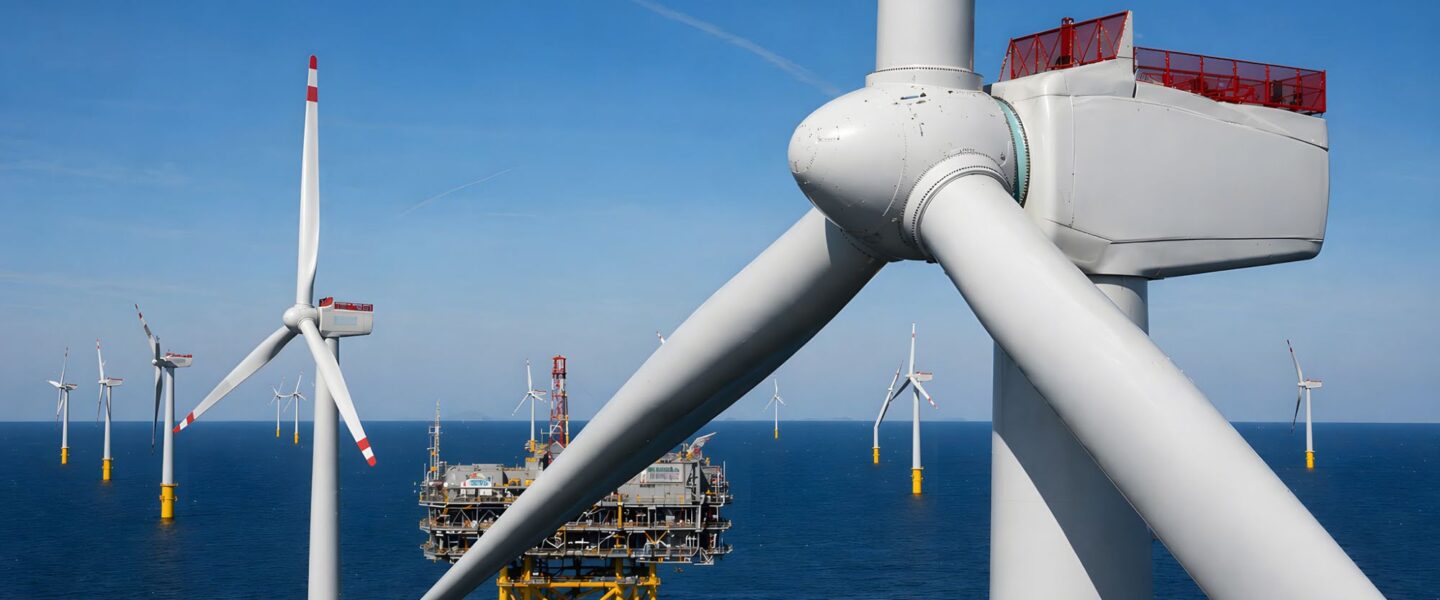
Offshore Wind’s Huge Clean Energy Potential Largely Untapped (Maria)
The author writes, “Winds sweep across the world’s oceans every day, and harnessing that largely unused resource has the potential to provide abundant, clean and reliable energy. Experts widely agree that marine wind could play a vital role in reducing fossil fuel reliance and tackling climate change. ‘The beauty of it is that the technology is tried, tested, proven, and has scaled,’ says Amisha Patel of the Global Offshore Wind Alliance. … Tapping into a tiny fraction of that potential could reap huge benefits: a 2025 paper found that using just 1% of the global area suitable for offshore wind could produce roughly 20% of global electricity demand.”
The Trouble with Trump’s Bunker and Ballroom (DonkeyHotey)
The author writes, “An additional day of reporting has largely confirmed the outlines of my morning-after analysis on Saturday night’s scary-but-contained security incident at the White House Correspondents Association dinner. Saturday’s incident was closer on the spectrum to the Clinton era “assassination attempt” when a guy opened fire on the White House with an AK-47 from the public sidewalk than it was to Butler, where the president was actually in danger. It was just a Hail Mary at the first line of security. … which brings me to the other weird unfolding current story about presidential security: Trump’s pet project of building a new presidential ballroom. In his remarks Saturday evening from the White House and in social media posts and court filings since, President Trump has used the shooting to attempt to justify and jumpstart his construction of a giant White House ballroom.”
US Mint Buys Drug Cartel Gold and Sells It as ‘American’ (Russ)
From The New York Times: “Every year, the United States Mint sells more than $1 billion of investment-grade gold coins. Each is stamped with an icon like the bald eagle, signifying the government’s guarantee, required by law, that the gold is 100 percent American. ‘To hold a coin or medal produced by the Mint is to connect to the founding principles of our nation,’ the Mint declares. But a New York Times investigation has found that the government’s program of gold sales is based on a lie. The Mint is actually the last link in a chain that launders foreign gold, much of it illegally mined, for an insatiable market. The Mint buys gold that originates in a Colombian drug cartel mine. It makes Lady Liberty coins out of gold from Mexican and Peruvian pawn shops and from a Congolese mine that is part-owned by the Chinese government, records show. Some Mint gold has come from a company in Honduras that dug up an Indigenous graveyard for the ore underneath.”
Corpus Christi Plans To Declare a ‘Water Emergency.’ What Does That Mean? (Dana)
The authors write, “No modern American city has ever run out of water. But chances are rising that Corpus Christi, Texas, could be the first. Absent a biblical rainfall event, its reservoirs are on track to completely dry up by next year. That raises baffling questions for the future of Texas’ eighth-largest city and one of the nation’s major petrochemical hubs. ‘We have no precedent to follow. There’s no manual, there’s no video,’ Corpus Christi City Manager Peter Zanoni told the City Council in March, when local leaders first acknowledged that disaster could be imminent. This week, Zanoni announced that Corpus Christi will require 25 percent cuts to water usage across the board in September. But at a City Council meeting on Tuesday, officials appeared deeply uncomfortable with exploring the details of how life in Corpus Christi might look under these conditions — and whether such ambitious conservation targets were even possible.”
A Dangerous Bacteria Is Moving Up the East Coast. Here’s What That Means for You (Sean)
From Gizmodo: “Bailey Magers and Sunil Kumar cut strange figures on Pensacola Beach. Bags of disinfectant solution surrounded them on the white sand; their gloved hands juggled test tubes while layers of rubber and plastic shielded their skin from the elements. As the two organized their seawater samples on the popular Florida shoreline last August, an older woman wearing a swimsuit walked over to ask what they were doing. ‘We’re just actively monitoring water quality,’ they told her, but she pressed on. ‘Are you looking for that flesh-eating bacteria?’”
Why Do Humans Age? Hint: Evolution Doesn’t Care If We Live Past 40 (Reader Jim)
From Forbes: “There’s something unsettling about the fact that the human body starts deteriorating once you reach your late twenties — and doesn’t stop. Your muscle mass declines. Your DNA repair rate slows down. Cellular waste accumulates in places it wouldn’t previously. Most people treat aging as a fact of biological humanity, which you eventually have to learn to accept. But for an evolutionary biologist, aging is something stranger and more interesting than mere wear and tear. In many ways, it’s actually paradoxical. Natural selection, after all, is ruthlessly good at its job. Over millions of years, it has sculpted organisms of staggering complexity, such as the vertebrate eye, the immune system, even the migratory precision of the Arctic tern. So why, after all that fine-tuning, did it leave aging on the table? Why didn’t evolution simply fix, or at the very least, optimize aging?”
A Tiny Arctic Village in Alaska Is Trying To Revive Its Polar Bear Tourism Industry (Reader Steve)
From the AP: “Late every summer, hulking white bears gather outside a tiny Alaska Native village on the edge of the continent, far above the Arctic Circle, to feast on whale carcasses left behind by hunters and to wait for the deep cold to freeze the sea. It’s a spectacle that once brought 1,000 or more tourists each year to Kaktovik, the only settlement in the Arctic National Wildlife Refuge, in a phenomenon sometimes called ‘last chance tourism’ — a chance to see magnificent sights and creatures before climate change renders them extinct. The COVID-19 pandemic and an order from the federal government halting boat tours to see the bears largely ended Kaktovik’s polar bear tourism amid concerns that the tiny village was being overrun by outsiders. But Kaktovik leaders are now hoping to revive it, saying it could be worth millions to the local economy and give residents another source of income — provided the village can set guidelines that protect its way of life and the bears themselves.”
