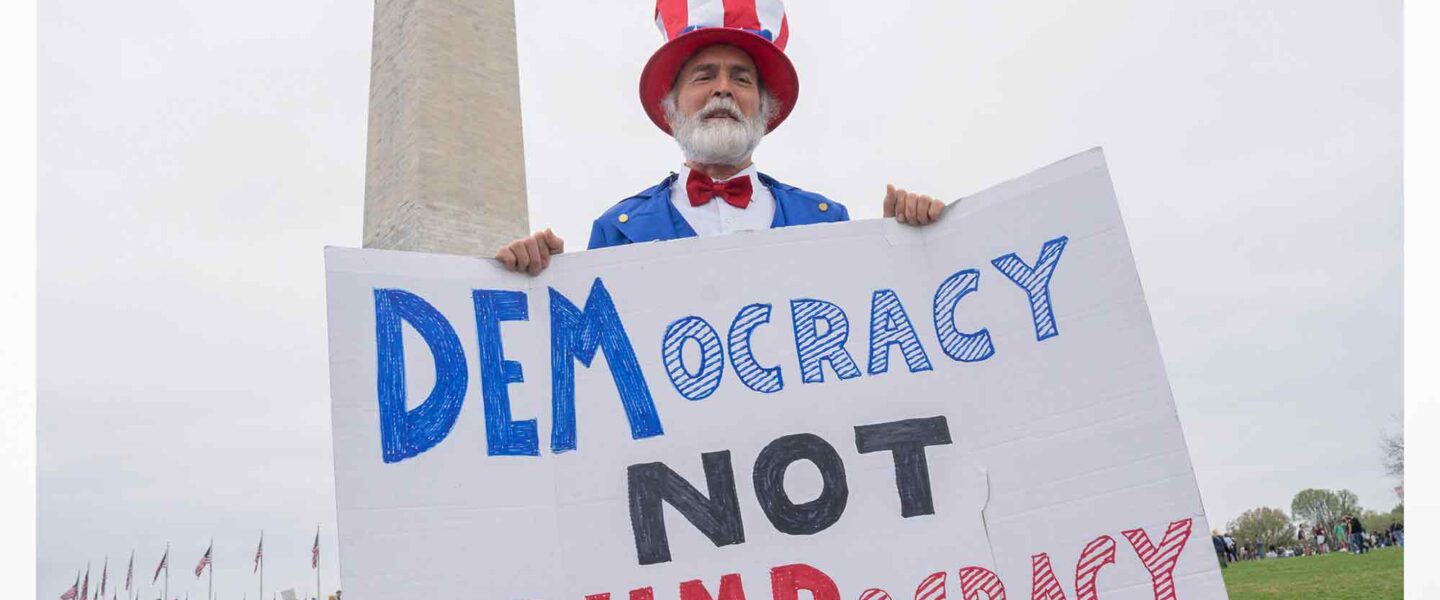
When an authoritarian regime offers no ideology, no story, no reason to believe, it plants the seeds of its own destruction. Minneapolis and Iran show this story.
Every authoritarian regime in history has understood something that Donald Trump apparently does not: People need a reason to go along. Not necessarily a good reason, or even a true one. But something they can tell themselves — some story, some larger purpose, some ideological cover that lets them live with their own compliance without having to examine it too closely.
This isn’t just about true believers. It’s about the far larger number of ordinary people who simply want to get through their lives — who will go along with almost anything, as long as they have something to hang it on. A slogan. A cause. A sense that there’s something bigger at stake than just the will of one man.
Václav Havel called it “living within a lie.” Every successful authoritarian project has understood it. Ideology isn’t just propaganda — it’s the psychological permission slip that makes acquiescence feel like conviction, that turns looking the other way into something a person can live with.
Trump has thrown that playbook out entirely. No story, no veil, no pretense of a larger purpose. Political theorist John Ambrosio, our guest on this WhoWhatWhy podcast, argues that’s not just a moral failure — it’s a structural one with consequences that are becoming impossible to ignore.
What happened in Minneapolis — the pushback, the fury, the refusal to be intimidated — wasn’t an accident. It’s what happens when a government built entirely on coercion and transactionalism runs into people who simply aren’t transactional. People whose own ideologies and moral convictions tell them what they’re watching is wrong.
The same dynamic is playing out on the world stage. Whatever one thinks of the regime in Tehran, the Iranians know what they’re fighting for — a 3,000-year-old civilization, a coherent sense of national identity, a set of beliefs people are willing to die for. Trump cannot articulate why we are fighting at all. No cause, no rationale, no ideological core. Just force, unmoored from any larger meaning.
Ambrosio, who brings a rare global perspective to these questions — he was a Core Fulbright scholar at the University of the Free State in South Africa — argues that what we’re watching isn’t just political chaos. It’s a regime that has built its own Achilles heel into its very foundation.
 Apple Podcasts
 Google Podcasts
 RSS
RSS
Full Text Transcript:
Jeff Schechtman: Welcome to the WhoWhatWhy podcast. I’m your host, Jeff Schechtman.
There is a moment in Vaclav Havel’s extraordinary essay, The Power of the Powerless, where he describes a greengrocer who puts a sign in his shop window. The sign carries one of the official slogans of the regime. The greengrocer doesn’t believe it. His customers don’t believe it. No one really believes it. But that’s not the point. The point is that it gives him a way to avoid looking at himself in the mirror. A small lie that makes a larger lie livable. A kind of permission slip, if you will, to go on with his day. Havel called it ‘living within a lie’, and for decades it served as the operational manual for every authoritarian regime that wanted to control a population without having to shoot everyone.
What Havel understood, and what the Soviets, for all their brutality, understood, is that people need an excuse. They need a story they can tell themselves about why they’re going along, why they’re not speaking up, why the discomfort in their chest every morning is just heartburn and not something more. Ideology isn’t simply propaganda. It’s not just noise filling the airwaves. It’s something more intimate than that. It’s the veil that hangs between ordinary people and an honest accounting of their own choices. It’s a cover story that makes complicity sound like common sense.
What makes this moment different? What separates Trump from the long line of authoritarians who came before him is that he has torn that veil away completely, unapologetically, even gleefully. He doesn’t offer excuses. He doesn’t bother with the fig leaf. He brags about the lawlessness. He fires people on television for sport. He extorts universities and law firms in broad daylight and then takes a bow. There is no ideological scaffolding, no appeal to something higher, no story designed to let his reluctant supporters tell themselves they’re doing the right thing. Just the raw exercise of power, offered up, naked and unadorned, as if daring anyone to look away.
And this turns out to be not just morally grotesque, though it certainly is. It may be a profound and perhaps fatal strategic miscalculation, because without the cover of ideology, without giving people a way to rationalize their own acquiescence, the only instrument left in the toolkit is fear, and fear applied at scale in a country with as complicated and deeply rooted civil society as the United States has a long history of producing exactly the thing that it is designed to prevent.
My guest today, John Ambrosio, spent his academic career at the intersection of education, power, and social justice. He received a Fulbright Program to teach and conduct research at the University of the Free State of South Africa, a country that knows from lived experience what it costs to finally dismantle a system built on coercion and carefully maintained lies. His recent essay in Three Quarks Daily brings Václav Havel into the same room with Minneapolis and Mario Savio, and asks a question that is both urgent and, in its way, quietly hopeful: What happens to an authoritarian project when it refuses to offer anyone, even its own reluctant supporters, a reason to believe?
It is my pleasure to welcome John Ambrosio here to the WhoWhatWhy podcast. John, thanks so much for joining us.
John Ambrosio: Oh, thank you. Thank you for the invitation, Jeff.
Jeff Schechtman: Well, it is a delight to have you here. First of all, talk about this idea of an ideological underpinning for any kind of an authoritarian regime and the way that that’s always been more or less, up until this point, the norm.
John Ambrosio: Yeah. I mean, I think you explained it very well in your intro that ideological excuses have always been absolutely essential to controlling populations in authoritarian states, that people do need some way of rationalizing their choices that don’t implicate them in the crimes of the regime. So it’s a very important aspect of authoritarian rule that I think gets overlooked sometimes. I mean, I’m very interested in sort of the psychosocial nature of political strategies, political control. And I think it’s something that is very important to consider, because without that, without the ideological cover, without some way to rationalize or excuse or mask their choices, then people have to face the reality of what they’ve actually chosen to do or to conform to. And so that’s what got me interested in this whole question. Was this issue of Havel’s essay… how did that play out in regimes? And then how does that play out now in the context of the Trump presidency?
Jeff Schechtman: Isn’t the idea of MAGA and “Make America Great Again,” is that not kind of the underlying ideological principle, as close as we could even find one with this administration?
John Ambrosio: You know, I think that is the sort of the broad ideological umbrella under which Trumpism operates. It’s not clear what that means, of course, but it’s a powerful, potent slogan that people can hide behind. “Make America Great Again.” Well, who wouldn’t want to do that, right? Assuming America was great in the first place. But that’s a very thin veil, it seems to me. That may work for some period of time with your most ardent supporters, but in a multiracial, very diverse democracy like we have in the United States, that’s not enough. That’s insufficient to govern with. And so Trump has this idea that he doesn’t need to explain his choices, his actions to anyone. He doesn’t need to consult the Congress. He doesn’t need to pay attention to public opinion he disagrees with. He has a divine king-like right to rule. And so having that kind of perspective in the midst of a well-established democratic culture, in a very diverse society in which at least or more than half the country disagrees with him, is a political strategy that is very weak and that is unlikely to succeed.
Jeff Schechtman: Isn’t that an inherent flaw with Trump in so many respects, that because he is such a narcissist, because he is so self-absorbed, that the idea of any kind of ideology that transcends himself becomes problematic, and that that is a fatal flaw, as you allude to in your piece, that that’s really a fatal flaw of his project.
John Ambrosio: It is indeed. You know, he doesn’t really have any strong ideological beliefs. It’s mostly, I mean, his focus is really primarily himself. He’s a narcissist, and he’s just so self-involved that ideologically he doesn’t have any really strong ideological commitments. And so, lacking that, he really has no sort of way of explaining himself other than talking about what he likes or dislikes or whatever. So it is a fatal flaw. And that’s what I tried to point out in the piece, is that as a political strategy, it’s a fatal flaw. I mean, you simply cannot try to rule a country like the United States, with its historical traditions and democratic culture, simply on the basis of “trust me.” I mean, that’s not going to work.
I mean, his inability — well, it’s not — I mean, he’s just really incapable of reaching out to his political opponents, to people that don’t agree with him. He has no interest in doing any of that. He doesn’t even have any interest, really, in working with Congress. So how does a king-like figure function politically in a country like the United States, with a long history and tradition of democratic politics and whatnot? And so what I was trying to really point out was the importance of civil society in this whole scenario — which doesn’t always get enough attention, I think — is that America, the United States, has a very strong and well-developed civil society. Now, Trump came — I mean, when he first took power, he just went full force trying to establish, consolidate his authoritarian rule, and he did a lot of damage in the process. But he’s run up against — and I think this is clear from the No Kings protests, from the recent elections — that he’s run up against the reality of American politics now. And what I tried to explain in the piece was that I think that this is going to put limits on what he can do, and very likely undermine his objective of imposing an authoritarian system on the United States.
He simply — I talk in the piece, I talked about the work of Antonio Gramsci, the Italian Marxist theorist, and his notion of hegemony, which is a combination of force and consent and persuasion—that ruling classes rule through a combination of those two things. And Trump only has one side of the equation, which is force and state violence, and has pretty much ignored trying to generate either the active or passive consent of the population through moral and intellectual leadership. He’s kind of overlooked all of that because of his penchant for unilateral power.
So I think that’s a fundamental weakness. And in a country like the United States, it leaves him with only one real option, which is to double down on state violence. And that’s part of what I was trying to get at in the piece. I was trying to look at Trumpism as a political strategy and its weaknesses. And I think it has some very fatal flaws we just talked about, but also to warn about what that might mean for the country, which is that if he doesn’t succeed — and I think it’s unlikely he will be able to consolidate his authoritarian power over the country — what next? What happens? How is he likely to respond, and how can we sort of prepare for that?
Jeff Schechtman: It’s interesting you talk about him not being able to reach out. In so many respects, reaching out involves compromise or discourse or understanding. And absent any ideological underpinning, any philosophical underpinning, reaching out becomes hollow, and one wouldn’t want to do it because there’s nothing to reach out to discuss.
John Ambrosio: Yeah, there’s nothing to discuss. And it’s also a sign of weakness from his perspective. So compromise is a sign of weakness. You just roll over your opponent. You bully them, you steamroll them, you do whatever you need to just get them out of your way. And that’s Trump’s attitude because he’s seen — in such as Trump, of course, it’s the leadership of the Republican Party — also have come largely to see compromise as betrayal, as betraying their values, their cause. So that it’s become a sign of political weakness, and it’s not something you want.
And this, of course — I mean, Trump sort of set the stage for all of this. It’s been brewing for a few decades, ever since the Gingrich sort of Revolution. But that’s — Yeah, so there’s nothing to talk about. But, you know, that’s why Trump never goes — even with the Iran war — why would he have to go to Congress? Why would he have to get congressional approval? Why would he even have to talk to the, you know, the Gang of Eight? Why would he have — he doesn’t have to do— he feels like he doesn’t need to do any of that. He believes he has this unitary executive power that he believes is sort of a king-like power, and he doesn’t need to do any of that, and doesn’t want to, really has no inclination to, and is kind of opposed to on a personal level.
Jeff Schechtman: Talk about the way in which oftentimes conspiracy theory and conspiracy ideas rush in to fill this ideological vacuum.
John Ambrosio: Well, that’s the thing. He only is really concerned with reaching out to his base, his core supporters, through lies and disinformation and conspiracy theories. And because it works with his base, he’s not concerned whether or not it works with the rest of the country. See, that’s sort of the thing. I mean, so he’s tried to fill that space, that void — that void where ideological excuses are supposed to function — with just lies, right? It’s just made-up stuff and conspiracy theories. And yes, for a lot of his base, they will uncritically absorb all of that stuff. But outside of his base — independent voters, Republican voters who are more establishment-oriented, and of course liberals and progressives — that’s not going to work. So, because he’s so unconcerned about what they think and appealing to them, he thinks he’s filling the gap successfully with this sort of endless stream of lies. But that’s what I was trying to get at with the piece, is that it’s not going to succeed, because a good part of the country — at least half or more of it — isn’t buying it. They’re openly critical. Trump simply is not interested in persuading them, and they’re not going to be persuaded on the basis of easily refutable lies, and obviously wrong information, and the crazy conspiracy theories. So that’s where — that’s the weakness of his regime. That’s the instability built into his regime. That is the fatal flaw, is that he can’t convince the rest of the country, and has no interest in doing so. And so he doesn’t have their support, won’t have their support, and what he’s left with is doubling down on what he’s been doing all along.
Jeff Schechtman: And he creates this illusion of transparency somehow by saying the quiet parts out loud, as if somehow that’s a strategy, and in fact it’s not, necessarily.
John Ambrosio: No, it’s not a strategy. It has the unfortunate effect of seeming to normalize his behavior because, well, who would brag about their illegal or unconstitutional behavior or their corruption, right? I mean, Trump puts it out there as a way to sort of neutralize any negative response to it. It naturalizes it because nobody would imagine that someone would sort of openly confess all of this in front of the nation. So it has that kind of perverse effect.
Also, you know, a lot of what Trump does is — he’s really a media creation, right? I mean, he’s really concerned with how things look in the media, how they appear in the media. I mean, he’s absolutely obsessed with how he appears, how he’s represented, et cetera, et cetera. And it’s kind of a way of confusing and neutralizing opposition. He says things that nobody else would say out loud, so there must not be anything wrong with it, because why would he do that? And then he just tries to confuse everybody with endless lies and counterlies, and then an endless stream of non sequiturs and incoherent rants.
So I think that’s how he tries to neutralize the opposition. He’s not interested in accommodating. What he wants to do is neutralize them, and he tries to neutralize them through this kind of propaganda — I would call it that — that he unleashes on the public on a daily basis. He wants people to get so demoralized and so sick of listening to the sorts of things that he says, the just absolutely awful things he says about people — and, you know, now he’s getting into a fight with the Pope, et cetera — that they just throw up their hands and walk away. He hopes he can just push the rest of the country away from even paying attention to what’s going on, and only reach out to his people.
Jeff Schechtman: And that’s an interesting thing. His mindset may be of old media in many respects, and yet the way it’s playing out, it is creating a kind of fatigue because of repetition, because of the reality of new media. And that fatigue is doing exactly what you say. It’s causing people to just completely turn off.
John Ambrosio: Yeah. Yeah, I think you’re right. I think because the media environment is so fragmented now, and it can’t be dominated by a few large networks the way things used to be, that there is always going to be this diverse sort of pushback. I don’t know, maybe in his own mind he really — I don’t know to what degree he believes what he actually says and to what degree he’s just saying stuff to get a response and to dominate the news cycle. But he doesn’t seem to understand that in the media environment in which he’s in now, that those things can’t be controlled or filtered in the way that it used to be, that with all these different outlets, all this fragmented media environment, that there’s no way that he can really dominate or control the news in the way he thinks he can.
Jeff Schechtman: What does history tell us about loyalty to an ideology and or philosophy, as opposed to loyalty to an individual, and which, if either, has the greater staying power historically?
John Ambrosio: Well, that’s a big question. But I think it depends on the nature of the society, on the degree to which… what the history of those societies are, what they’ve historically been exposed to or accustomed to. But ideology is a powerful thing. I mean, there’s a reason why authoritarian and totalitarian regimes have always relied heavily on ideology, because they understand that people need a way to make sense of, rationalize, hide behind some excuse that will allow them to live their everyday lives without being completely humiliated by their sort of quiet support of the regime. So they’ve always understood that.
I think strongman politics is less stable. I think it’s less reliable. I think you saw what happened to Viktor Orbán even after sixteen years in power. He just got shellacked, as Obama would say. And so I think it’s unstable. I don’t think it has — I don’t think strongman regimes have lasting power, because they have less of an ideal. They have less of a hegemonic sort of hold on the society. You know, it’s again just ignoring what people think and what they say and how they understand their lived experience. It’s very important how they understand their lived experience, how they make sense of it, and how they can distance themselves from the regime’s crimes, whatever.
So I think, in my view, ideologically strong regimes — regimes that use both force and coercion, but also consent, that are concerned with at least achieving the consent or the passive consent of the population through ideological excuses — are the more stable regime.
Jeff Schechtman: Also, the degree to which even supporters are willing to take any kind of a risk at all seems stronger when there’s an ideological core and a reason to take that risk.
John Ambrosio: Yeah, I think people — once again, it sort of overlooks what people need to live. People need meaning. They need purpose. They need to have stories that will help explain their reality, their everyday lived experience. Those things are important, and that’s what ideology can do, right? So people need to believe that what they’re doing is good, is decent, is the right thing, even if that’s not true. They need an ideological excuse that will enable them to believe it. That’s, I think, essential to any kind of governing strategy.
Jeff Schechtman: The other ideology, such as it is, that underlies Trump, besides MAGA, which we talked about earlier, is the idea that somehow transactionalism is some kind of ideology.
John Ambrosio: Yeah. He’s surrounding himself — Trump and the people that he surrounds himself with — they’re not ideologues. They don’t have any — I mean, their whole thing is get rich, right? They want to get rich. They want to get rich quick. They’re grifters. It’s like a whole government of grifters, right? They’re not moved by ideology. They don’t really believe in much of anything. What motivates them is mostly money and power.
I think that’s one of the things that’s so distinctive about the Trump administration — Trump and his cronies — is that almost all of them — I mean, some of them may have more ideologically based beliefs — but for most of them, it’s not the case. They’re simply in it for themselves. They want power. They want media exposure. They want to become fabulously wealthy. That’s what motivates them. So if they have any ideology at all, it’s that sort of capitalism, right? Excessive capitalism. They want to feed at the trough. They want to squeeze out as much money as they can while they’re still near the levers of power.
Stephen Miller, what’s his ideology? He simply wants to get rid of all the immigrants, right? I mean, Trump’s ideology is put his name on everything and his picture on everything, and grift as much as he can. And the whole—his meme coins and all of that. I think that’s what is distinctive about them, and that’s their weakness, again, politically, is that they don’t have an ideology. They don’t really believe in anything, whatever it might be. I mean, Orbán believed in what he called the liberal capitalism, but he actually had beliefs. There were things that he was actually trying to achieve.
I don’t think that’s the case with Trump at all. I think what he’s trying to achieve is whatever benefits him and his friends the most. And so that’s the inherent weakness of the Trump regime, is that even if you disagree with his ideological commitments, he doesn’t really have any. So how do you — that’s partly why he’s so unpredictable.
Jeff Schechtman: There’s also a danger inherent in that, in that because there isn’t an underlying ideology, that to the extent you’re governing through fear and the threat of violence or the threat of anything, that it makes it easier, arguably, for institutions, for universities, for law firms, you name it, it makes it easier to cave, because you’re not caving to an ideology. And somehow that makes that easier, I think.
John Ambrosio: It might, yeah. I guess because there are no clear ideological demands on the table other than “do what we say.” But the people who wrote Project 2025 are ideologues. And even though Trump hasn’t implemented that entire program, it’s sort of a guiding light in many ways for the people who are lower down in the administration or the cabinet levels and whatnot. They’re more ideological. They know what they want to achieve. Russ Vought knows what he wants to achieve, right? He’s an ideologue. He’s got a plan. He knows what he wants to achieve, and they’re doing it. Trump sort of — he’s not interested in really governing, right? So he’s delegated most of his power to lower-level officials: just do whatever you want. Pete Hegseth, whatever you want. He’s not really interested in the details of governing. He’s not really interested in any of that.
But the more ideologically driven people in the administration are, and the people behind Project 2025 and the whole Heritage Foundation thing, those people who came into the regime, they do have an agenda. They do have something they want to accomplish. They want to destroy the sort of liberal constitutional regime we have in the United States. They want to replace it with something else. Trump is like, okay, if he thinks it serves his political interests, he’ll go along with it. But it’s not like he’s driven to attack, say, trans people or something like that. It’s not part of his — he’s not really concerned about that, only to the extent that it will either help him politically. Otherwise, I think he has no interest in that sort of stuff. Whereas people like the conservatives who follow Orbán, they want to do away with LGBTQ+ people. They want to do away with trans people. They want to reimpose a more traditional patriarchal society. They have a plan. They know what they want. Trump just wants to destroy things he doesn’t like and profit off things he can.
Jeff Schechtman: So one wonders what the combination produces, that if you have a transactionalist, a narcissist at the top, and people below that are actually doing the governing with their own ideological agendas, how that ultimately plays out and where that cognitive dissonance takes you.
John Ambrosio: Well, that’s why you see some of them going off the deep end now, right? I mean, he’s going through, like Kristi Noem, okay, there was too much bad press. I mean, it was hurting him politically, and she also had her own ambitions. And he doesn’t like that either. So he had to get rid of her. So there’s always a lot of churn in his regime, his administrations, the previous one and this one, there’s quite a bit of turnover, because when his desires, whatever they are, conflict with the ideological project of people below him, there’s a problem, and he’ll get rid of them if they’re causing him too much trouble. He’s trying to hold together a political coalition on the basis of very little. His political coalition is fracturing now, I think, partly because they actually do have beliefs that conflict with his own. I mean, the whole launching the unconstitutional, unnecessary war with Iran has really put a wedge into his coalition. The fact that he’s badmouthing the Pope — I mean, he’s obviously unhinged — there are cracks forming because there are conservatives, conservative Christians that are part of this coalition, that don’t like him badmouthing the Pope. And so he gets JD Vance to do it too. He’ll kind of use other people to carry out his wishes.
Trump operates like a mafia don, right? He just sort of expresses indirectly — but clearly — what he wants to happen, and then people are supposed to go and make it happen. So he kind of rules like a mafia don. And when people displease him, for whatever reason — if they make him look bad, if they embarrass him, if they don’t do what he wants, I mean, Pam Bondi wasn’t able to indict the people and prosecute the people he wanted prosecuted — then they have to go. Plus, her testimony in front of Congress was pretty awful.
He’s unpredictable partly because he’s unhinged, but it’s also because he doesn’t believe in anything other than enriching himself and his friends. So that’s a part of the fatal flaw in their governing strategy, is that they think everybody else is more or less like them — that they’re transactional, that they’re mendacious, that everybody’s out for themselves and everybody’s willing to do whatever it takes to get whatever it is they want, regardless of who gets hurt in the process. They think everybody’s like that, and when people suddenly act differently, it’s confusing to them. What happened in Minneapolis was confusing to them because it was completely unexpected.
Jeff Schechtman: What do we learn from Minneapolis? What does that teach us?
John Ambrosio: It teaches us that pushback does work. I think it teaches us that Trump, really, he’s a Trojan horse. I think what we’ve seen over and over again is that when — Trump is a bully, and when bullies get pushed back on, they often retreat, which is typically what happens, right? So I think what happened was, first of all, they had no conception that people would fight back in the way that they did. They just couldn’t believe that anybody would put their life at risk for anybody else. All those suckers — remember, Trump, when he was in France, talking about all the soldiers that died, they were just “suckers” because they lost their lives for what? Didn’t benefit them, right? So they believe everybody is like that, and they surround themselves with people like that, so they think the whole world is like that. And then when they discover, as in Minneapolis, that people aren’t like that, that there are lots of people who actually do believe in ethics and do have a moral core and will protect their neighbors, it shocked them, I think.
And then what happened was they pulled back, right? They retreated. And I think that’s what’s happens over and over again. So I think the lesson is that if you give in to Trump, he’ll just keep stomping on you, but if you push back, you’re likely to win that round. I think Trump is really a weak person and a weak leader. All the bombast and all, it’s all to really mask a deep insecurity. So when you push back against him and he begins to look really bad in the press, he will backpedal, and he has so many times in the past. He’s a TACO, right?
And so I think that’s the lesson. I think the lesson is that fight back — fighting back works, and that the more you fight back, the more likely you are to succeed. That he really has a weak regime, he has a weak hold on power, he has a weak hold on the country, and he knows it at some level. He probably knows that. And so pushing back, and pushing back forcefully — calling out his lies, every time he does something lawless and unconstitutional, just constant pushback — and I think that’s why that was my focus really on civil society, because civil society pushback is the way this regime will be defeated, in my view.
Jeff Schechtman: Which brings us really full circle to this point, that it’s much easier to push back on somebody who is weak because there’s no core, there’s no philosophy, no ideology behind it. There’s nothing behind it which enhances the weakness.
John Ambrosio: That’s right, that’s right. It’s not like it’s ideological warfare. It’s not that at all. It’s just people wanting to defend their neighbors and the guy who’s siccing the people with the guns on them, right? There’s no explanation. There’s no ideological excuse. There’s no ideological explanation for what he’s doing. So it doesn’t become a left versus right thing. It really is a right versus wrong thing. And that makes it even more difficult for him, because having an ideological excuse, a reason, a way to explain things, puts you in a much more powerful position than simply saying, “we’re just going to go after the worst of the worst.” And then people see what’s happening, and they know that’s not the case.
And then you’re left with what? Nothing. There’s no way to defend yourself, right? There’s no way to explain what’s happening. Why are you doing what you’re doing? So without an ideological sort of club to wield or hide behind, you’re much weaker. You’re much weaker politically. And I think that was really part of what I was trying to get at, is that Trumpism is not an ideology. It’s really more like a psychological state of mind. I don’t know what it is, but it’s not something that will enable you to convince yourself that you’re doing the right thing.
Jeff Schechtman: It’s transactionalism. I guess that’s again — it comes…
John Ambrosio: Yeah, it comes back to this transactional thing, which is for him everything is transactional, right? And for a lot of the people that work for him, it’s the same thing. But that’s not the way a good part of the world is. I guess he’s been ensconced in these circles for so long that he’s completely lost touch with how the rest of the world lives, and he really thinks everybody is like him. I guess Roy Cohn must have convinced him that everybody was more or less like him. I don’t know what happened, but at some point he’s just lost touch with reality and thinks everybody is transactional, and treats everybody as if they were transactional. And when they don’t act that way, he’s surprised and doesn’t really know how to respond.
Jeff Schechtman: John Ambrosio, I thank you so very much for spending time with us today.
John Ambrosio: Oh, thanks, Jeff. It’s been a great pleasure. Thank you.
Jeff Schechtman: Thank you. And thank you for listening and joining us here on the WhoWhatWhy podcast. I hope you join us next week for another WhoWhatWhy podcast. I’m Jeff Schechtman. If you like this podcast, please feel free to share and help others find it by rating and reviewing it on iTunes. You can also support this podcast and all the work we do by going to WhoWhatWhy.org/donate.