
It’s a dark day for a democracy when it has to take lessons from a monarch.
|
Listen To This Story
 |
Powerful tension hung in the room as King Charles spoke before a joint session of the US Congress.
Directly behind him, the vice president and House speaker traded eyeball daggers — as if the veep was watching the speaker for clues on which statements he could safely applaud…
Statements about countries getting along, avoiding war, respecting differences of opinion, and the rule of law. About the value of NATO, about countries working together, against isolationism, about supporting Ukraine. Even about ensuring the continuation of human life on earth.
All of which run directly counter to the agenda and actions of Donald Trump and his team.
Watching this unfold on Fox News, I could see that the king’s elegant but gentle jabs were ruffling no feathers. The Fox folks were respectful and omitted their usual snarky commentary, partly because this was a kind of “sacred” event where the usual bile would have no place, and partly because there simply was no need: Most of this was flying above their audience, and few would get the ironies, or sense the restrained alarm in his voice.
Nor would they realize the king was politely talking about a nightmare — one that was actually enabled by the Fox audience itself.
The New York Times’s coverage, meanwhile, was not inaccurate, and it was, as one expects of such an august publication, politely analytical. But it did not exactly say what one might well conclude: that Charles came knowing just how volatile the reality is, with America in the throes of one of its most perilous situations ever, run by one of the most dangerous persons ever to lead any major country.
(And, it appears, the king also came braced for this dangerous person’s infamous handshake. When he first arrived, Trump reached out and, with a vise-like grip, tried to jerk the king toward himself. But numerous commentators have marveled at how Charles yanked right back toward himself, even engaging his shoulder in this tug of war.)
Nevertheless, in a situation like this, pageantry becomes the official story, and the actual crazy gets normalized — homogenized down to a nonconfrontational style of reporting. Journalists, even as they offer veiled critiques, end up serving as adjuncts to what the government wants us to report. It’s how it was planned. It’s a publicist’s dream.
Bring in an actual king, bestow flattering light on our own would-be king, distract from the mess he has made and the danger he represents. This is how it will get reported. It’s crisis management, PR 101.
The Times is of course politically light years away from Fox, but still extremely deferential and understated.
Journalism can do better. It can explicitly remind people how it all affects them. Directly. The costs and the consequences. And it makes me ponder: What would transpire if the legacy media owners demanded that their staff always speak the truth?
It might look something like the reader comments posted in response to the Times coverage.
Virginia Cynic wrote:
to trump it just proved that his view of himself as a king was recognized by another king and the press covers it like a second coming sought by all his fundamentalist admirers and its effect is just what trump craves —chaos of which he is the center and chief, and coverage of the most corrupt thieving president who also specializes in taking what are essentially bribes from billionaire oligarchs, lying, threatening and trying to exact revenge on people who have angered him, killing people on the open ocean, mistreating people of color, and starting stupid money wasting wars when he has no real goal and strategic acumen, all while not caring that he is doing nothing to help the people of his country.
so, great coverage of another distraction.
ImproveAirVentilationInBuildings saw something good come of Charles’s visit:
You know you are in deep trouble when a leader from a monarchy visits and openly and clearly reminds Congress about their duty to provide checks and balances. USA is at a pivotal moment. King Charles was the perfect messenger for this urgent plea.
Authoritarians and Humor
It’s been days since the royal visit to the US, and I found myself pondering what we might learn from it. Then I came upon a piece the Times had about young Arab-world humorists. It observed, “In a region shaped by monarchies, authoritarian governments and conservative values, comedy is one of the few outlets to say in veiled critiques what often can’t be said outright.”
It’s not just the Arab world, I thought. It’s our world. Consider these New York Times headlines from that Wednesday morning:
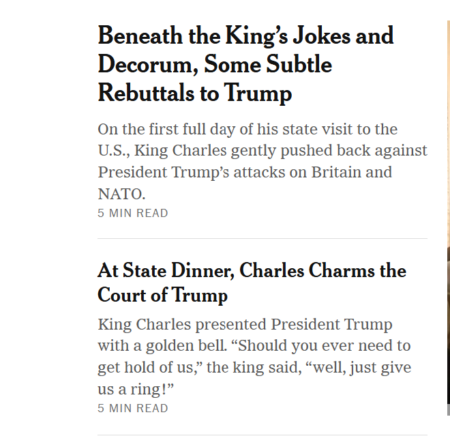
And this may have nothing to do with subtle criticism of the administration from the Times, but it did report the evening’s entertainment, and it seemed to have a not so subtle message from Trump — a rather militant message — for his royal guests:
The evening’s entertainment will feature performances by the United States military musicians from the Marines, Army and Air Force, including “The President’s Own” United States Marine Band, the United States Army Chorus, the United States Army Strings, the United States Army Herald Trumpets, the United States Air Force Singing Sergeants and the United States Air Force Strings.
‘Things Fall Apart; The Centre Cannot Hold’
The royal visit — and what was left unsaid — does underline just how really bad things are for the United States and the world at this moment, because of the Trump administration’s potent mix of incompetence, corruption, and brutality.
Everywhere you look — notwithstanding the continuing irrational, know-nothing, see-nothing, optimism of Wall Street — are signs of collapse. Here are just a few:
The growing number of foreign, and even American students eschewing our elite US universities for European universities, where application rates are soaring.
Canadian travel to the US dropped by 20 percent, and Canada’s imports from the US hit record lows last year.
Rural hospitals are closing their maternity wards or closing completely.
Farmers are paying more for everything and have fewer customers.
What was left of one of our signal achievements, the Voting Rights Act, just bit the dust.
Confidence in the efficacy and integrity of the American government and system is so low that a judge recently openly wondered how the Justice Department is supposed to defend the IRS — defendant in a massive $10 billion lawsuit — when the plaintiffs are… the president and his family.
Such collusive suits are, to be blunt, corrupt — add it to the long list of Trumpian grifts. You basically settle with yourself and pay yourself from the public till. But $10 billion?! Hey, why not? Trump always likes to do things bigly.
There was a time to speak out early on, but the real influencers — elected officials, the wealthy, the media — did not. Only ersatz influencers did, random people or even nonpeople (bots) that large numbers rely on without knowing anything about them or their credentials. We may find ourselves suffering the consequences of this misplaced trust for a long time.
Among the consequences is the diminution of real journalism at a time when it’s already threatened by the public’s growing appetite for podcasts by these randos.
According to a new study, it’s not just MAGA types who are trusting total strangers with no pedigree. It’s Democrats and Republicans alike, in similar numbers.
Add to that the consolidation of media outlets, and the takeovers by oligarchs who kowtow to Trump.
CBS is falling fast after being taken over by an oligarch, and his next targets include CNN. CNN in turn is the home of a personal favorite of mine, the Reliable Sources column by the admirable Brian Stelter. It’s a place where we learn on a daily basis what’s going on with the industry that informs us about our country and world.
What will happen if CNN, already less than ideal in some respects, is neutered or hollowed out, and what happens to Stelter’s operation in that case?
And as Stelter notes, the World Press Freedom Index, which rates countries on how they treat their media, found this year to be the worst overall in the 25 years it has been published.
In some countries, journalists face grave mortal danger, but even in the US, things have deteriorated. We rank… 64th in the world(!) in markers of “freedom of the press.” That’s down seven places from the previous year — in the country that first enshrined that very phrase in its constitution. Consider how Trump constantly brags that the US is No. 1 in so many things. No mention of this issue — which he has markedly influenced with the continuous attacks he and his minions have launched.
Even the media itself doesn’t cover this well. I get it: You don’t want to “talk about yourself.” But if the media won’t, who will?
The good news about how the public gets its information — that declining portion of the public that still cares what happens — is the role of YouTube and other video streaming services in bringing you powerful scenes from inside Congress.
****
As mentioned, some people are tuning out. Not me, and not our team at WhoWhatWhy. We’re just getting warmed up for the battle ahead.
However, though I don’t recommend tuning out what is happening, I am discovering the joys of voluntarily slowing down. For me, this means reducing the number of things I aspire to achieve every day, being more selective about where I focus my attention, taking each experience more slowly, and stretching out the good things that life brings me. This of course runs counter to the warp speed of our world.
One thing we’re doing at WhoWhatWhy is including more poetry in our mix and, more generally, a bit more coverage of things cultural — things that might just be worth finding time for. One of my colleagues here keeps asking where exactly it is that we’re all trying to get to so fast, and what paradise do we expect to find when we get there?
These, I think, are questions worth pondering — slowly.
Here’s some help with slowing down:
Carl Honoré: In praise of slowness | TED Talk
The art of living a slow life: debunking ways to slow down time. – The Boar
Graceful Simplicity: Toward a Philosophy and Politics of Simple Living
Slowing Down as the World Speeds Up | Psychology Today South Africa