The redistricting war continued Monday with the Supreme Court paving the way for Alabama to use a racially gerrymandered map and Virginia Democrats appealing the decision that invalidated their attempt to redraw the state's congressional districts in their favor.
|
Listen To This Story
 |
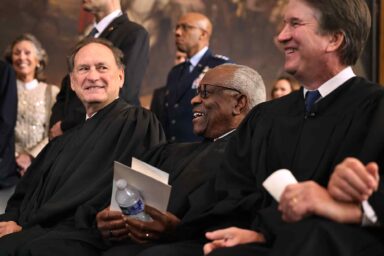
The Supreme Court on Monday continued its quest to help Donald Trump and his Republicans rig the midterms in their favor. This time, the partisan judges gave Alabama the green light to redraw its congressional map to dilute the vote of its African-American residents and eliminate at least one of the districts held by Black Democrats.
The decision comes on the heels of the court gutting what was left of the Voting Rights Act (VRA) at the end of April. Since then, Republicans have been aggressively moving to gerrymander their states in ways that disenfranchise minority voters.
They hope that this unprecedented mid-decade redistricting campaign will yield them an extra dozen seats in this November’s election.
In a scathing dissent, Justice Sonia Sotomayor noted that the lower court’s ruling that had invalidated the map that Alabama is expected to revert to was more wide-ranging than Louisiana vs. Callais, the decision that essentially invalidated the VRA.
“The Court today unceremoniously discards the District Court’s meticulously documented and supported discriminatory-intent finding and careful remedial order without any sound basis for doing so and without regard for the confusion that will surely ensue,” Sotomayor wrote.
She added that it is up to the lower court to decide whether the Callais ruling affects its earlier decision.
Also on Monday, Virginia Democrats asked the Supreme Court to allow the state to use a voter-approved map that gerrymandered the commonwealth in their favor.
Their appeal hinges on the definition of when an election begins (or at least it would hinge on that if the justices were not partisan operatives).
The Virginia Supreme Court based its decision on what it said was a flaw in the process used to put a new congressional map on the ballot of an April 21 referendum. Specifically, the ruling said that, in its rush to counter Republican gerrymandering efforts elsewhere across the country, the General Assembly last year failed to pass an amendment giving it the authority to draw the new map “prior to the next election” because early voting had already begun.
According to Virginia law, the measure had to be passed in two consecutive legislative sessions before voters could approve or reject it.
However, Democrats argue that the court’s interpretation of what “prior to the next election” means is flawed. According to the decision, that phrase did not mean the actual election day but rather the period from when early voting began.
This, according to the emergency filing, contradicts federal law and the Trump administration’s own position in another case.
“[The Virginia Supreme Court’s decision] depended on a grave misreading of federal law that no other court, state or federal, has ever accepted and which numerous federal courts have expressly rejected,” state Attorney General Jay Jones wrote.
While that may be true, the most likely outcome here is that the Supreme Court will rule against the Democrats by pointing out that this case involves the state constitution, which usually gives state supreme courts the final say in the matter.
However, that would at least allow Democrats to point out the hypocrisy of the high court’s conservative judges, which has been on full display in a series of redistricting cases.
That’s because they are likely to allow Republican-led states like Louisiana to stop primaries in which voting had already begun to allow them to gerrymander their maps.
That may be a small consolation for them, but it will highlight the partisan nature of the Supreme Court. That could be a topic in the midterms when Democrats can make the case that the only way to check the Trump administration is for them to control Congress, since the high court is essentially a rubber stamp for just about anything the president wants.