With Republicans and Democrats trading accusations that the other side is trying to “steal” elections, it is important to distinguish between actual fraud, legal ways in which one party in particular is trying to rig the system to their advantage, and the ravings of a delusional president who cannot handle defeat.
|
Listen To This Story
 |
Shortly after Virginians approved a temporary electoral map on Tuesday to level the playing field in the upcoming midterms and respond to Donald Trump’s ordering red states to create some more Republican seats in the House, the president went on social media to complain that the election was “rigged.”
It’s a familiar refrain from the inventor of the “Big Lie.” Whenever Trump loses, he claims that it’s because of unspecified “fraud” or nebulous forces “rigging” the election.
And while the president has never been able to prove any of his allegations, he has managed to successfully undermine US democracy like nobody else in history — and not only through his rhetoric but also by his actions. After all, Trump’s accusations are usually an admission of guilt or signal his intent to engage in some unsavory/illegal behavior.
That puts defenders of democracy in a tough spot. On the one hand, they have to point out that past elections, like the one Trump lost in 2020, were fair and free from fraud. On the other hand, they also have to warn Americans that the president and his party are constantly trying to give themselves an edge in ways that may be legal but are highly undemocratic.
We, for example, have often pointed out how Trump and the GOP are trying to “rig” the midterms. In addition, both Democrats and Republicans have made “election integrity” an important part of their respective platforms.
So, what’s the difference?
First of all, it’s important to distinguish between “election fraud,” “election rigging,” and “the delusions of a whiny old man not being able to acknowledge he lost.”
Let’s address the last one first.
Donald Trump is a thin-skinned liar who suffers from various mental disorders that do not allow him to ever admit defeat. Therefore, whenever the president makes an allegation related to one of his election losses, you can rest assured that it is made up because his malignant narcissism compels him to do so.
Next up is “election fraud,” an actual crime with serious penalties.
Even though there is virtually no upside to committing individual voter fraud, Republicans claim it is rampant. Depending on which of them you ask, between hundreds of thousands and millions of people are doing it and risking imprisonment, fines, and deportation.
That last one is especially important because, according to Trump and his supporters, it’s mostly “illegals” who are guilty.
By the way, when we say “depending on which of them you ask,” we don’t mean actual experts. Because if you ask those, they will tell you that individual voter fraud is one of the rarest crimes in the US.
For example, more than 400 people were charged with committing acts of violence or assault on January 6 as they tried to overturn the results of the 2020 election. That’s one out of every 25 people who protested outside the Capitol that day.
Compare that to instances of voter fraud committed by noncitizens. According to the conservative Heritage Foundation, that happened in only about 1 out of every 15,000,000 votes cast in federal elections since 2000.
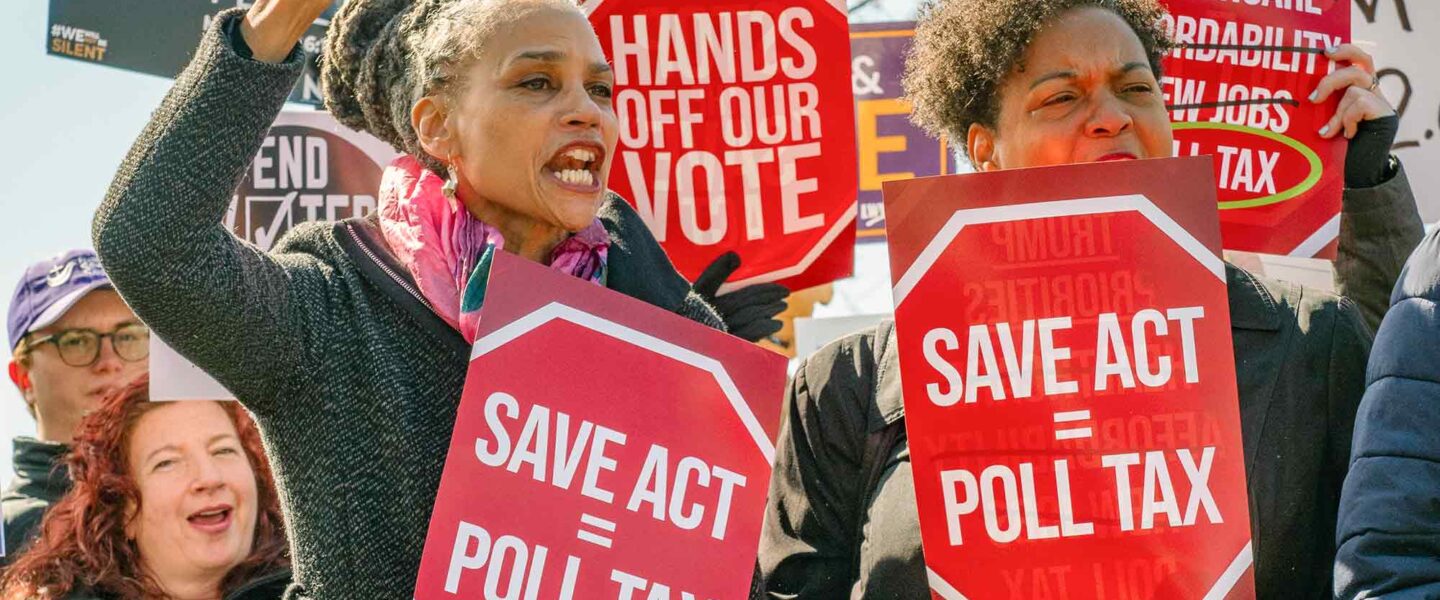
Of course, that’s not what supporters of the SAVE America Act will have you believe. That’s the name of the bill that is Trump’s top legislative priority. It’s supposed to make sure that only citizens vote in US elections, which is already what is happening. It does a few other things as well, but we’ll circle back to those in a minute.
Obviously, voting as a noncitizen is only one way to commit voter fraud. However, all of the others, such as vote buying or fraudulent use of absentee ballots, are also exceedingly rare.
And while Trump’s Big Lie is meant to convince the public that election officials were involved in various schemes to rob him of his “victory” — for example, by using Italian satellites, bamboo ballots, or licorice voting (OK, we made that one up, but it’s as plausible as the others) — nobody in the president’s orbit has ever been able to produce credible evidence to back up those accusations.
In other words, it’s all bogus.
“Election rigging,” however, is very real.
In fact, you can make the case that most elections in US history have been rigged in one way or another. For example, only white men were allowed to vote in the first 20 presidential elections. In 1870 the 15th Amendment to the Constitution guaranteed Black men the right to vote. It took another 50-plus years before women were allowed to cast ballots.
All of this was perfectly legal (until it wasn’t), which is the main difference from election fraud. But that doesn’t make it right — which is why the laws were eventually changed to ensure that women and US citizens of color can freely cast ballots.
However, other ways to rig elections remain legal and widespread. Gerrymandering, for example, which is what “blue” Virginia has just done (following the example set by “red” Texas), is a scheme for “rigging” the midterms. It is an odious practice that ought to be outlawed,because it allows politicians to pick their voters instead of the other way around.
But that doesn’t mean that anything untoward happened in Tuesday’s election. Well, except perhaps from activists opposing the new electoral maps, who used misleading fliers to make it sound as though Barack Obama agreed with their opposition.
That’s shady but not illegal. In fact, very little is illegal anymore when it comes to rigging elections. For that you can thank the Supreme Court, which has gutted the Voting Rights Act, the Civil Rights Act, and various campaign finance laws.
In most cases, it’s Republicans and associated groups who want to pick and choose who gets to vote.
In the olden days, that could be achieved with poll taxes and literacy tests carefully designed to exclude Black people.
Nowadays, the GOP’s disenfranchisement efforts are more sophisticated. People in urban areas tend to vote for Democrats, so Republican officials close polling locations in cities or position them far away from public transportation. Students tend to be more progressive, so Republicans ensure that college IDs can’t be used by would-be voters to identify themselves. Studies show that minorities like to vote early on weekends, so tight restrictions are placed on early-voting hours.
Each year, provisions like these and others with similar intent are passed in state legislatures across the country. Some of them get tossed out by the courts, many of them don’t.
Which brings us back to the SAVE America Act, which is one of these disenfranchisement efforts. Under the guise of addressing a problem that doesn’t exist, the president and his Republican allies want to make voting more difficult for demographics that usually support Democrats — such as women and minorities.
And, of course, these GOP election manipulators trust that “their” justices on the Supreme Court will find a way to make these provisions legal… even though they can’t make such blatant discrimination right.
And that is how you rig an election.