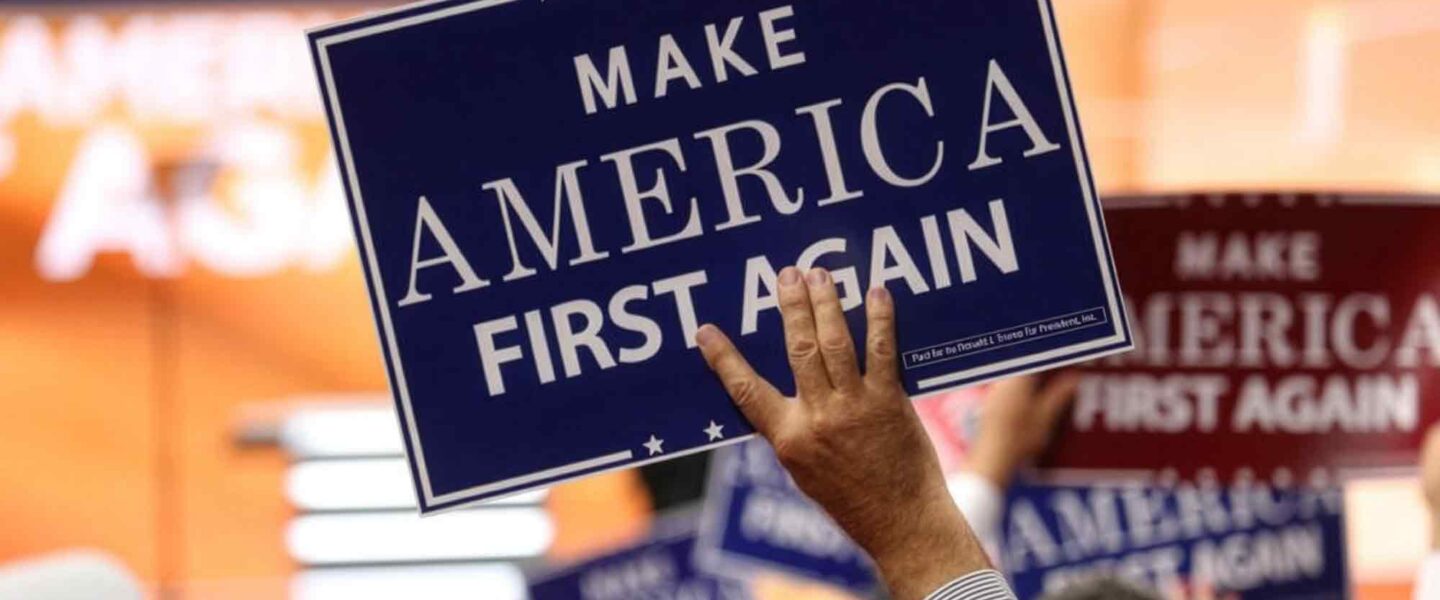
If “America First” means leaving the US without friends in a world where everybody needs some, then Donald Trump is doing a great job.
|
Listen To This Story
 |
A war requiring flyover rights and bases in allied countries, a hostile nation holding hostage a key maritime passage, a global economic disaster in the making, the outbreak of a dangerous virus — these are the types of crises in which it would be nice to have friends.
Unfortunately for the United States, after 15 months of Donald Trump “putting America first” and alienating just about everybody else in the process, it doesn’t have many friends left.
Sure, there are the countries comprising the “Board of Peace,” but the vast majority of them aren’t exactly stalwarts of democracy or beacons of virtue. Then again, neither is the US these days.
Which brings us to the organization’s “chairman for life” and what he has been up to.
More than anything, Trump has been isolating the United States with almost every major decision he has made since beginning his second term.
The president’s tariffs, which he has wielded like a weapon, have disrupted global trade and hurt the economies of many US trading partners.
He has threatened some of America’s once closest allies with taking over their territory. In doing so, he has forced Canada and the European Union to find partners elsewhere, which is going to hurt the US economy in the long run.
His administration has abruptly cut off life-saving aid to some of the poorest countries, which is just one of many examples of the US yielding its once extensive “soft” power. As a direct consequence, there have already been hundreds of thousands of preventable deaths, with millions more to come.
In at least one case, the administration is trying to use the threat of withholding medical aid to get a country to offer the US more access to its rare minerals.
Trump has withdrawn the United States from international organizations and treaties like the World Health Organization and the Paris Agreement. The former is particularly noteworthy right now following a hantavirus outbreak.
While experts are hopeful that the deadly disease can be contained, this is exactly the kind of crisis that WHO is made for: coordinating the response to a global public health emergency.
That kind of international cooperation would be absolutely vital if the spread of hantavirus were to worsen — or another pandemic threat emerges — since the Trump administration has fired most of the US experts in this field. In other words, to save American lives the administration would have to rely on the good will of WHO, an organization it still owes $280 million in dues.
Speaking of dues, this week, the US asked the United Nations to support a resolution demanding that Iran halt attacks on ships passing the Strait of Hormuz and stop mining the waterway.
That’s the same UN that Trump keeps maligning and wants to replace with his Board of Peace.
In other words, the president constantly complains about the United Nations — to which the US owes more than $4 billion — but now that he needs something, he expects it to do his bidding.
This will sound very familiar to NATO, which Trump has been undermining for years (thereby playing into Russia’s hands). Over the past year, in particular, he has frequently threatened that the US could leave the transatlantic alliance, and he recently ordered the withdrawal of American troops from Germany to punish the country’s chancellor for criticizing him.
He never bothered to consult with member states before attacking Iran. However, now that the war is turning into a major headache, he expects the rest of NATO to clean up his mess.
Which brings us to the president’s boondoggle in the Middle East.
By attacking Iran, and failing to foresee the havoc the regime in Tehran could cause by closing the Strait of Hormuz, he has plunged the global economy into chaos. This is especially true for the many Asian countries that depend on energy from the region.
Thailand, for example, has been a US ally for decades. However, now that it is feeling the brunt of the war’s impact, the Trump administration has done nothing to alleviate its pain. As a result, Thailand is turning to China and Russia for help, which will further erode support for the US on the Asian continent.
Even countries that assisted in the attacks on Iran at the beginning are now irked by the erratic way Trump has conducted the war. Saudi Arabia, for example, was reportedly upset when the president announced that the US Navy would begin guiding ships through the Strait of Hormuz. The Saudis were understandably concerned this would jeopardize a shaky ceasefire that had raised hopes of a resumption of oil shipments. So Riyadh notified the Trump administration that US forces would not be allowed to use Saudi airspace or American bases in the kingdom to support what Trump had dubbed “Project Freedom.” As a result, that operation was subsequently “paused.”
And then there are all of the small ways in which this administration is ensuring that people from across the world are thinking of America last — for example, when it comes to where the best and brightest international students will attend college or where people will vacation (and spend money).
If you add it all up, it’s not surprising that even (former) allies have a poor view of the US. A recent poll among Europeans showed that they view the United States as a greater threat than China.
While a lot of this has to do with Trump, it doesn’t mean that all of the damage he is causing will be undone as soon as a Democrat takes office and reverses many of his policies.
In some cases, it could take many years before some countries again consider the US a reliable friend, ally, or partner, or for top students to seek entrance to an American university and not one in Europe or China.
Trump’s die-hard supporters may hail these isolationist policies as “putting America first.” In reality, however, they are ensuring that the US will fall further and further behind in the big-power competition for global power and influence.
