The Supreme Court’s right-wing majority wants Americans to believe that racism isn’t an issue anymore in the US. Donald Trump and Republicans across the South demonstrated this week that it is alive and thriving.
|
Listen To This Story
 |
Long after the last slave was sold, the last time a Black community was eradicated for doing too well, and the last African American was lynched, racism remains alive and well in the United States.
However, it is important to distinguish between two types of racism — both of which were on full display in US politics this week.
On the one hand, you have the kind of racism displayed by Donald Trump and Rep. Jen Kiggans (R-VA).
On Monday, the president shared three videos whose sole purpose was to portray Black people in an unflattering light.
Earlier in the day, Kiggans was interviewed by radio show host Rich Herrera, and the two talked about the Democrats’ effort to gerrymander Virginia.
Herrera said that if House Minority Leader Hakeem Jeffries (D-NY) wants to meddle in the state’s politics, he should move there and run for office.
“If not, get your cotton-picking hands off of Virginia,” he added, to which Kiggans enthusiastically assented.
“That’s right,” she said. “Ditto. Yes, yes to that.”
This is the kind of racism one can do very little about. Obviously, it’s not great that it exists, but you can’t legislate someone’s personal views.
In other words, there will always be bigots like Trump, Herrera, and Kiggans.
It’s a whole other story when someone like that, having risen to a position of power, makes decisions based on their racist worldview.
We just saw plenty of examples of that as well.
In fact, the Supreme Court’s ruling in Louisiana v. Callais not only gutted the Voting Rights Act (VRA), it also demonstrated that racism continues to be a driving force in the South.
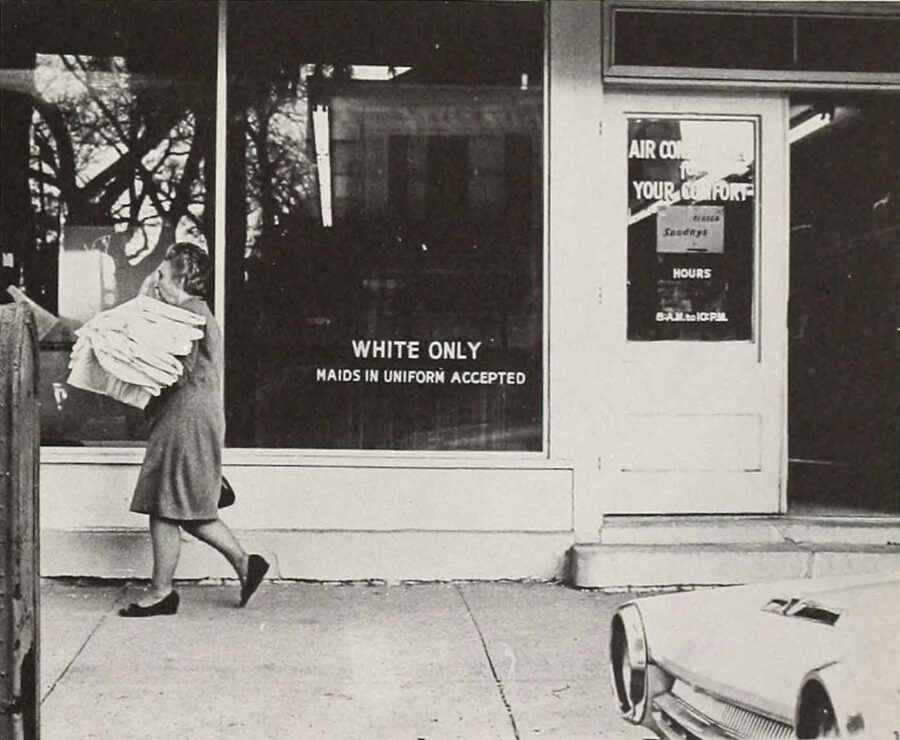
Photo credit: Unknown / Wikimedia (PD)
Laughably and conveniently, both in this decision and in Shelby County v. Holder, which took a sledgehammer to another part of the landmark civil rights law more than a decade ago, the court’s right-wing majority argued that racial discrimination is much less of a factor in the South now.
Within hours of the Callais ruling, Republican lawmakers in Louisiana, Mississippi, Alabama, South Carolina, Tennessee, and Georgia proved them wrong by putting in motion long-plotted schemes to render the votes of their Black residents irrelevant.
And they weren’t particularly coy about it.
“[Rep. Bennie Thompson’s] reign of terror in MS-2 is over,” exulted Mississippi Gov. Tate Reeves (R). “It’s not a matter of ‘IF…’ Just a matter of ‘WHEN!’”
In South Carolina, the justification for redrawing the district of Rep. Jim Clyburn (D) is that he does not represent the rest of the state.
“I like him personally, but he does not represent the rest of South Carolina, which is conservative,” said Rep. Ralph Norman (R-SC), noting that a plurality of voters in South Carolina’s 6th Congressional District are African Americans.
But Clyburn isn’t running for governor or senator, so his job is to represent his constituents, not everybody else in the state. However, since Republicans can’t beat him fair and square, they’ll change the maps.
In Louisiana, the governor declared an emergency to stop a primary in which tens of thousands of people had already voted.
In Tennessee, the GOP took the city of Memphis, which has more than 600,000 residents (of which nearly two-thirds are Black), and allocated pieces of it to three different districts, thereby diluting the African American vote enough to ensure that Republicans will likely win all of them.
When Democrats in the state Legislature objected, they were stripped of all committee assignments, as though they were obstinate slaves refusing to toil in the fields.
Because in the Volunteer State, making sure that Black voters get no voice in choosing their representatives is A-OK, but protesting against such a racist power grab is not.
Some of these plots have already succeeded, and others still could.
In the end, there will be significantly fewer Black lawmakers in Congress, and millions of African Americans will no longer get to have a meaningful say in who represents them in the House of Representatives.
That is the point, of course.
It is this kind of racism that is much more insidious and impactful than Trump sharing videos of an African American woman not paying for her food or young Black men shoplifting.
And while it is nearly impossible to do something about individual bigotry, racism perpetrated by the state must be fought.
Because if it isn’t, then it will fester, as it did in the South after the Civil War.
In the decade or so immediately following the conflict, the North kept the rebel states on a very short leash. For a few years, things looked up for Black people in the South and across the nation. Slavery was outlawed, African American men got the right to vote, and some of them were elected to Congress.
Ultimately, however, Reconstruction failed because federal leaders could not achieve both of its objectives: reintegrating the states making up the Confederacy back into the Union and integrating Blacks into society, especially in the South.
In the end, the leadership in Washington decided that the former was more important. The boot came off the neck and the South immediately reverted to its old ways.
Wait, that sounds familiar!!!
From then, it took nearly 100 years of Jim Crow laws and segregation before meaningful civil rights legislation forced the South to be less racist after nothing else had worked.
And those laws did their job. For half a century, the Voting Rights Act curbed the excesses of deeply entrenched southern bigotry and gave Black voters a voice in Congress.
Until Shelby County and now Callais.
The lesson here is simple.
The next time Democrats are in charge, they have to once again put on a tight leash those states that have demonstrated that they are unable to keep their racist ideology out of politics.
The bottom line is this: You can’t prevent individual racism, and you can’t even prevent racists from gaining power. However, it is imperative to put in place laws and other checks to keep them from using that authority to force their bigotry on everybody else and not, as the Supreme Court has done, enable them.